
The original Tavor, dubbed the TAR-21, made big news when it arrived in Canada a few years ago. The compact bullpup design, which sets the action back in the stock, reducing the overall size of the rifle for a given barrel length, combined with the non-restricted status for any rifles with a barrel over 470mm, made it a huge hit not only with tactical shooters but with anyone interested in taking light rifles into the field. It took standard AR-15 magazines, it had a track record as a battle-proven service carbine, and it was exotic without giving up a lot of functionality. Shooters lined up to shell out the not-insignificant price, and the Tavor became a Canadian favourite, at least among people who were comfortable shooting multi-thousand-dollar service rifles.
But not everything about the original Tavor was perfectly executed. The trigger was, in a word, awful. The magazine release was poorly designed and required either contortions or letting go of the pistol grip with the firing hand; neither solution was especially appealing. It was an adequate infantry rifle for a country with a conscript army that issues its dedicated shooters M4 carbines. But it wasn't a gunfighter's gun, nor did it excel in competition as some Canadian shooters discovered: the slow magazine changes and poor trigger were just too much of a disadvantage.
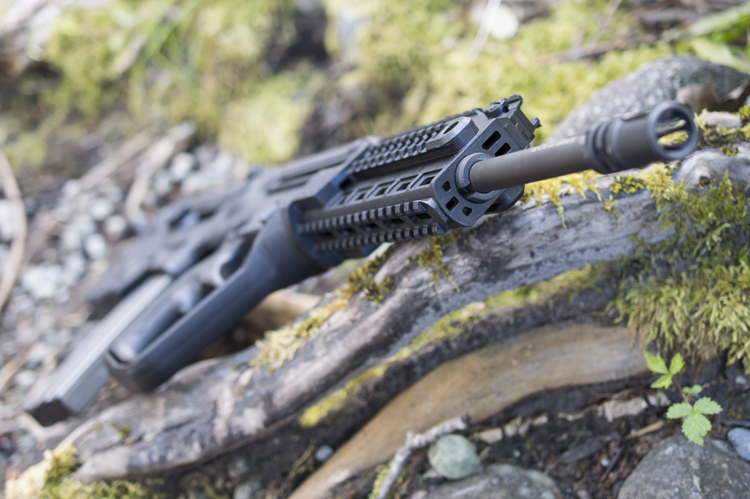 But the Tavor's manufacturer, Israel Weapon Industries, lost no time in announcing a new model which would address some issues, and also appear in a more svelte form, for while the original had been short, it had also been rather chunky in appearance (not that anyone would expect a bullpup to win a beauty contest). But for those who wanted a better, more compact Tavor, help was on the way in the form of the Micro Tavor or MTAR-21, which would be known on the civilian side of the street as this: The X95.
And it's taken some time to get the X95 into Canada. User requirements included, aside from a new trigger and magazine release, a new pistol calibre carbine in 9mm joining the rifle in 5.56mm NATO (although the 9mm is as yet unavailable in Canada), the ability to mount suppressors as necessary, and better ergonomics overall. The updates were made and, eventually, the new X95 wound its way through Canada's byzantine and arbitrary classification system and into stores, upgrades ready for testing.
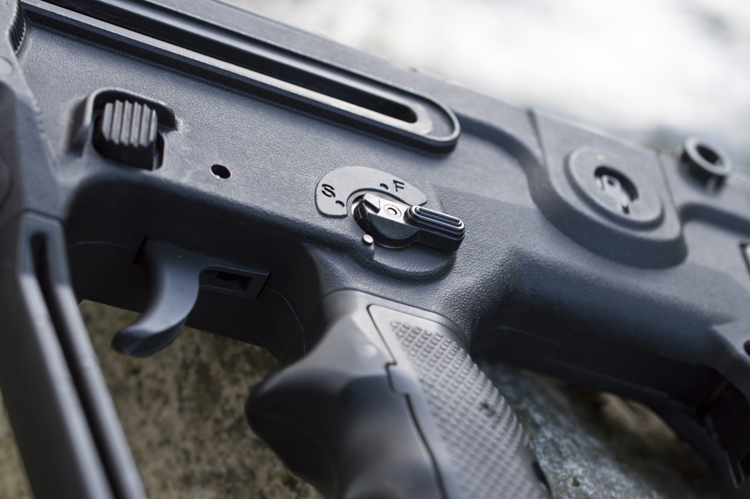
 But of all the demands placed on the new model, every one paled in comparison to the trigger issue, so let's address that now: The old one was terrible. The new one is good, with a clean break, a positive reset, none of the grit or slop of the original and half the weight. This feels like a clean, smooth, 5 pound trigger. It's a bit longer than an AR trigger but not intrusively so. For a bullpup, the trigger is great.
And what about the magazine release? The original was in almost the worst spot we could think of (we kept being told to just hit it with the back of our firing hand, but there is something about letting off our primary grip and then quickly reacquiring it on a pistol grip with a fully exposed trigger that makes us really uncomfortable) and we're happy to say that enough people at IWI agreed that it's been replaced with a conventional pushbutton, much like an AR-15.
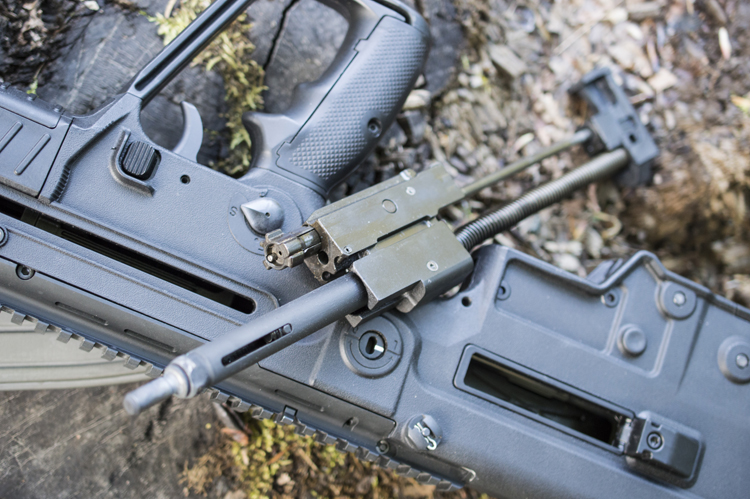
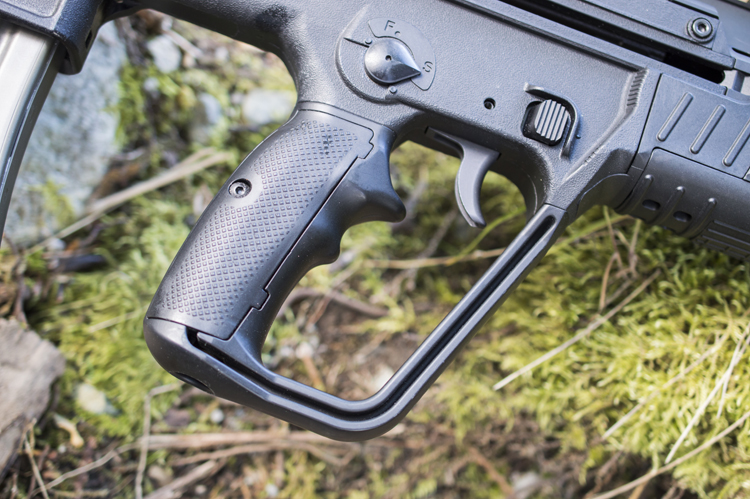
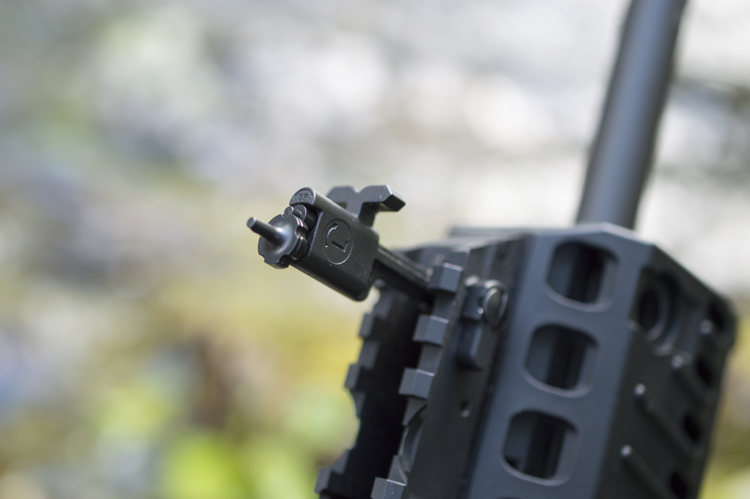
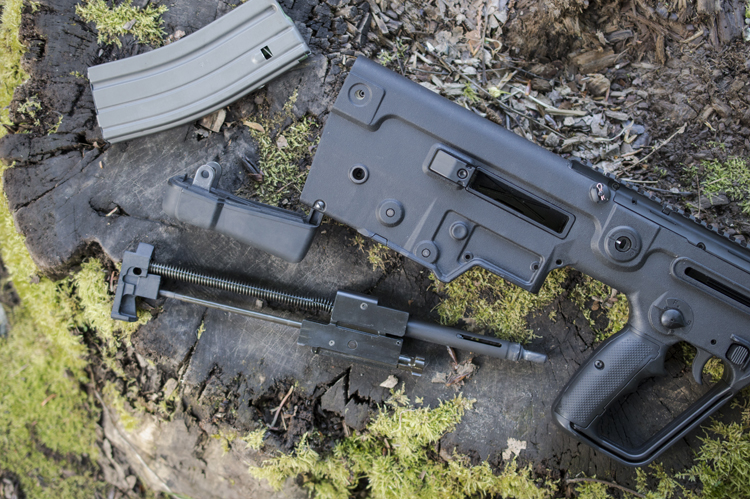 Finally, the entire package was made slightly more modern, with a simplified stock, a bit less weight (about half a pound less) and improved ergonomic features. Those included a steeper grip angle, some very nifty integral backup iron sights, and increased modularity in the form of an integrally railed handguard.
Well, if you give us a more compact version of a popular rifle, with the two biggest flaws addressed and some bonus features, what's not to like?
Okay, we'll admit that opinions of Calibre staff were somewhat divided at first. One esteemed member of the team, recently seen luxuriating in the company of the superlative Anschutz 1771, fairly sniffed at the lack of checkered, figured walnut before retreating with his pipe into an overstuffed leather armchair with a snifter of brandy; another promptly denounced the bullpup as an inefficient fighting platform, then flung Arc'teryx LEAF catalogues at us and did kettlebell exercises until we felt uncomfortable and left. There was only one way to settle this: At the range, with eleven different types of ammunition.
 The X95 is not designed with extreme accuracy in mind, and our expectations were not especially high as we set up our lead sled on the bench. Our first realization was that the standard rifle rest was not designed for bullpups, and the only way the Tavor would fit in the rest was on an awkward cant, which made the process a little fiddly. Additionally, dropping the magazine after each group required us to forcibly remove the carbine from the rest, as the magazine itself would wedge tightly against the frame. And, of course, the rest itself had insufficient rear elevation adjustment to get the point of aim down low enough to hit targets at a reasonable height. So despite our massive 15-60x reference optic, we set the distance at 50 yards, hoping to get results that at least seemed passably accurate.
The results we got were not at all what we expected.
Now let's start by saying most people have a fairly distorted idea of how accurate rifles usually are, because on the internet, everyone claims to shoot cloverleaf groups at any distance they want. Furthermore, it happens to be that the most popular carbine in the western world, the AR-15, lends itself extraordinarily well to tuning for accuracy, and most of us are used to seeing free-floated barrels, often fairly thick and relatively short, which makes them extremely rigid. The X95, on the other hand, has a barrel that's longer than a typical AR these days, definitely not free-floated, with its teflon sleeve near the rear of the barrel and “stabilizing sleeve” further forward. We'd heard people saying 3-4 minutes of angle (MOA) but given most shooters' rather optimistic take on accuracy, and the fact that a lot of bulk ammunition itself isn't actually capable of printing much better than two or three inches at 100 yards, we thought that we might be looking at a five to six MOA gun.
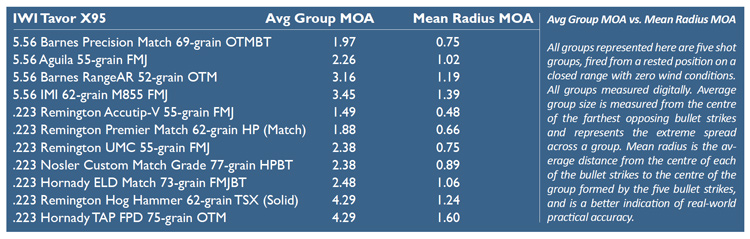
 In fact what we saw was that at worst, with the rifle awkwardly placed into our rest, the rear of which was sitting on a pair of PMags to get the elevation right, the X95 shot 4.29 MOA, using Remington Hog Hammer ammo and, oddly, Hornady TAP. But from there it got better. A lot better.
The best cheap bulk ammo was Aguila 55 grain, at 2.26 MOA, followed by Remington Freedom Bucket 55 grain, at 2.38 MOA. That's about as good as you can expect from bulk .223. But some of the premium ammo got really impressive results, given the limitations of the platform: Barnes Precision Match was just under 2 MOA, Remington Premier Match 1.88 MOA, and Remington Premier Accutip an astonishing 1.49 MOA, although strangely the point of aim/point of impact of the Accutip ammo was significantly different than every other ammo; while extremely repeatable and precise, it shot 2 MOA to the right of every other bullet.
 Interestingly, there appears to be no particular correlation between bullet weight and accuracy; the most accurate bullet was 55 grains and the least accurate was 75 grains, but the heavy 77 grain Noslers were right in the middle of the pack. In general there appears to be a slight advantage to lighter weight projectiles but it's difficult to say if that's a function of the rifle or of the particular ammunition we had. It’s also worth noting that the X95 is a long-stroke gas-piston operated rifle, so pressure curves will play a big role in operating the rifle’s action in a consistent and repeatable fashion; a key component in developing or finding an accurate load.
 Having satisfied ourselves that the X95 is perfectly adequate in regards to accuracy, we had to admit that the rifle was better than we'd initially thought. The new backup iron sights work well and fold down into the top rail when not in use, and while the Tavor isn't well suited to lead sleds, that's not where we do most of our shooting anyway. Treated as an infantry rifle, it makes quite a bit of sense. Offhand shooting was quite easy on account of the added rearward balance of the X95 compared to the standard Tavor, and the slight loss of mechanical accuracy relative to a platform like the AR-15 is offset by the ease with which the user can keep the rifle steady. We also liked the more vertical grip, compared to the standard Tavor's rakish profile.
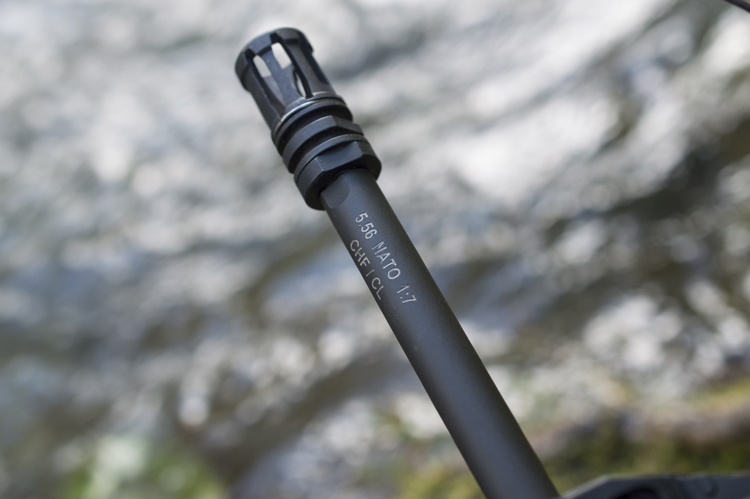
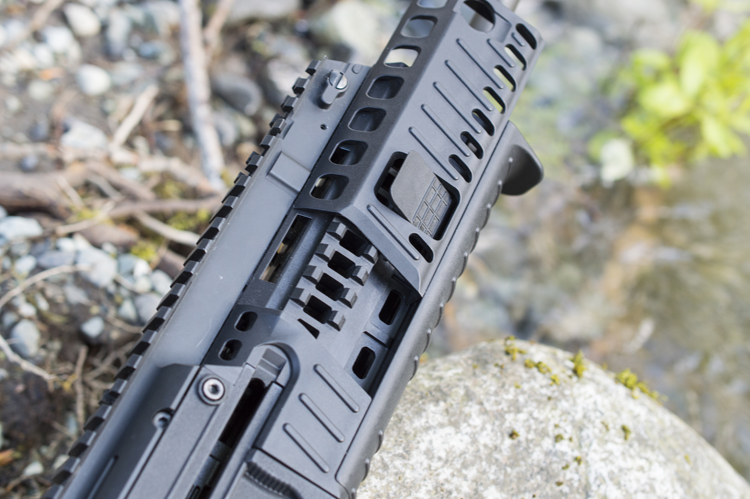
The integral picatinny rails under the handguard, with integrated rail covers that slide off when you press on a little lever-tab, are pretty slick. It's a compact, handy rifle that needs nothing but whatever optic you want. It's got a 1:7 twist, chrome lined, cold hammer forged barrel, and it's non-restricted so you can take it wherever you want. It can be set up for left or right handed shooters, and it's definitely a fun gun.
The X95 isn't cheap, retailing for around $2700, but then restricted AR-15s with a similar pedigree aren't really much below two grand, and they're range toys only.
 Downsides include those which are inherent to the bullpup design: reloads are slower than conventional magazine changes, for example, and the bolt release is in an awkward spot on the bottom of the stock. We found that empty PMags were not as likely to drop free when the mag release was pressed, although aluminum magazines worked well. The charging handle seems strange to us: when the bolt is locked back, it doesn't seem to have anything to prevent it from sliding back and forth willy-nilly, and when the bolt is in battery, the handle itself flops oddly on the bolt handle stub. And, of course, the trigger guard design is something you either love or absolutely despise. We're a little unnerved by it, as we're used to using the bottom of the trigger guard as an upward hand stop when we're not actively shooting and our trigger fingers are stretched out on the side of the receiver. Losing that hand stop makes the trigger seem extremely exposed to us, and we'd prefer a conventional trigger guard (which exists, and they're modular and easily swapped out, if you can get one.)
Certainly, this rifle is not without quirks and we suspect some people will be put off by them enough that they don't think it's worth the ticket price. But if you're looking for a bullpup in Canada, or just the most compact, non-restricted, battle-tested .223 you can get, the X95 is your huckleberry.

 SUBSCRIBE TO CALIBRE MAGAZINE
$30.00 / year
SUBSCRIBE TO CALIBRE MAGAZINE
$30.00 / year
 UNAPOLOGETICALLY CANADIAN MEN'S T-SHIRT
$29.00
UNAPOLOGETICALLY CANADIAN MEN'S T-SHIRT
$29.00
 UNAPOLOGETICALLY CANADIAN WOMEN'S T-SHIRT
$29.00
UNAPOLOGETICALLY CANADIAN WOMEN'S T-SHIRT
$29.00