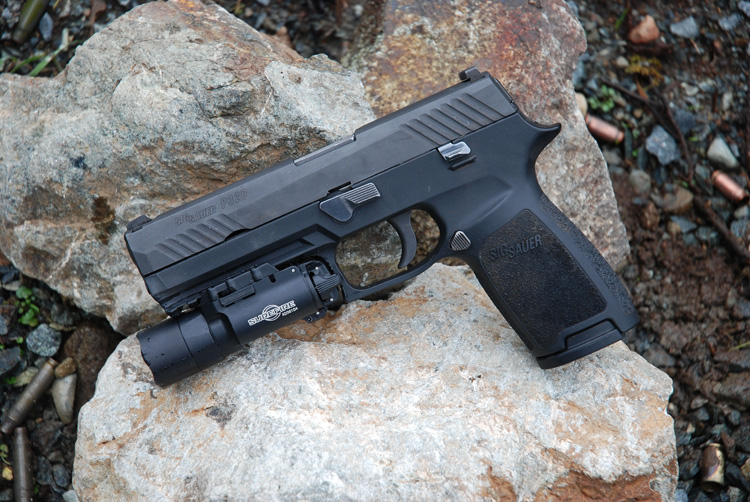
SIGs latest offering, the P320, is their first foray into the polymer-framed, striker-fired pistol market. A market which we all know has very tough competition from many, well-proven pistols. So, for the P320 to stand a chance, the good people at SIG had to come up with something special. Did they succeed?
Let me admit, right off the bat, that I carried, and used, a SIG P226 for many years as a soldier and private security contractor. It became a part of me. An extension of my arm. As far as I’m concerned, the P226 is the most combat proven pistol on the planet. Therefore, yes; I am a SIG fan, but this will not bias my review. Firstly, because I don’t particularly like polymer-framed handguns; I tend to prefer the heft and solidity of an all-metal gun. And secondly, precisely because I’m such a SIG fan, I have exceedingly high expectations of their products. If something didn’t measure up, I would be the first to call them on their shortcomings.
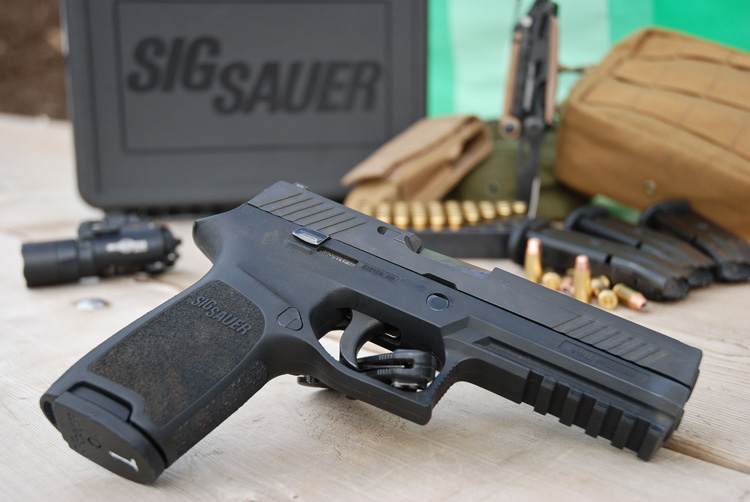 I must also mention that SIG did not send me the P320 as a freebee for testing. Nor am I writing this review based on a week or two of trials. I purchased this firearm myself in the summer of 2014 (it was one of the first imported into Canada). I have used it for my personal training, and to teach others, for the past year and a half. I have put over 10,000 rounds through it. It has been shot in a variety of weather conditions from a 30°C British Columbian summer, to a -30°C Albertan winter. I did not acquire the P320 so I could review it; I acquired it so I could use it!
My Full Size P320 is chambered for 9mm Para. It arrived in a reasonably sturdy plastic case, and included: two excellent 10rd mags, a kydex holster, a keyed cable lock, an orange chamber flag, and a manual. The supplied holster is worth a brief mention because, simply put, it’s garbage. Cheap and poorly made. Firearm retention is awful and cannot be relied upon to keep the gun secure. The holster’s paddle attachment is also a waste of time. I tried it once and it has been gathering dust ever since. Overall, it would have been better had SIG reduced the price by $50, and not bothered including the holster.
Speaking of holsters; because it’s so new, accessories for the P320 are currently few and far between, but that should change as the pistol becomes more established. It’s not too much of a worry though because the P320’s dimensions are the same as the well-known P250, so they can share holsters.
Now, let’s get stuck in to the gun itself. I have broken down my findings, and listed them in order of importance:
1 – Safety
This is my main priority when purchasing any firearm. It must function safely. Always and forever. And, as expected, the P320’s design and construction is safe; it only ever went bang when I told it to.
2 – Accuracy and Reliability
 For obvious reasons, these two areas tie for second place in my order of priorities.
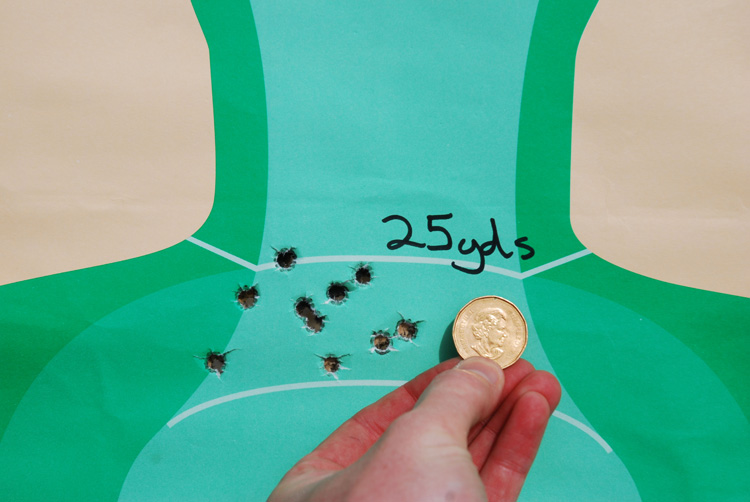
As you’d expect, the P320 was far more accurate than I am. It always hit everything I asked it to, from 5 yards to 25. If groupings were less than awesome; the fault was mine, not the gun’s.
Any gun I own has to be soldier-proof. If it can’t take a beating, then it has no place in my safe. And during my usual training, the P320 has taken plenty of beatings. It has been dropped and banged around; it has gotten wet, dirty, and been covered with snow. And it has always functioned flawlessly.
 Over the last eighteen months, I have not experienced a single malfunction that wasn’t ammo related (bad primer etc.). Of the 10+k rounds I have fired, some have been from the reputable factories of Federal and Hornady; some have come from overseas manufacturers who I haven’t even heard of; some have been factory reloads from BDX or CRS; some where brass cased, some were steel; projectiles varied from 115gr FMJs to 135gr +P JHPs. The P320 ate them all.
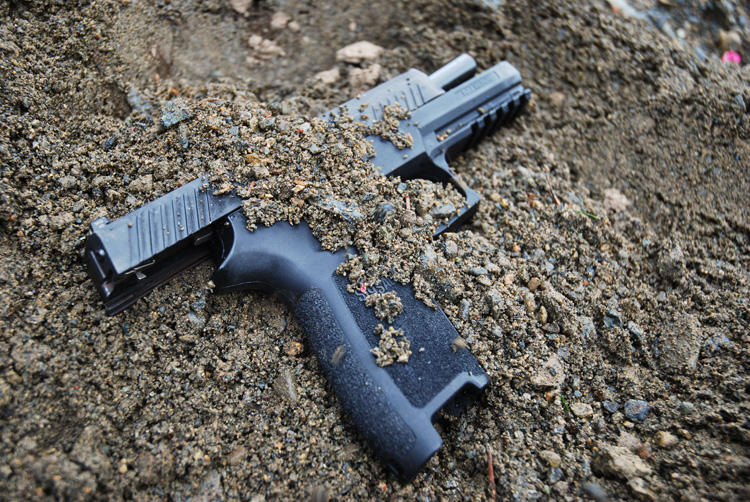
When it comes to reliability, this is a fairly impressive track record, and some might consider it to be proof enough. But here at Calibre, we like to push the boundaries of reasonable firearms use. So recently, on one surprisingly sunny Vancouver Island weekend, a buddy and I decided to see how much environmental torture it could handle.
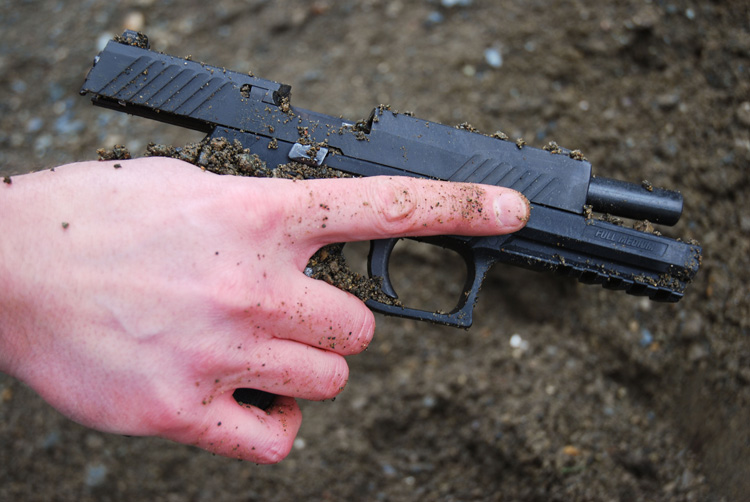
 First, we dug a hole in the gravelly dirt and buried it, action open. Grit and sand found their way through every gap, into every hole, and, as we should have predicted, prevented the slide from going fully into battery. So we stripped it and gave everything a shake off. Then reassembled, loaded, aimed, and pressed the trigger. Bang. It ate an entire mag with no stoppages.
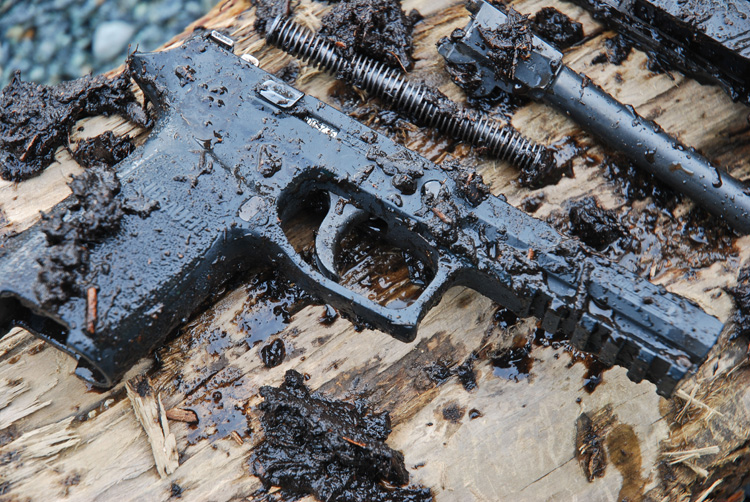
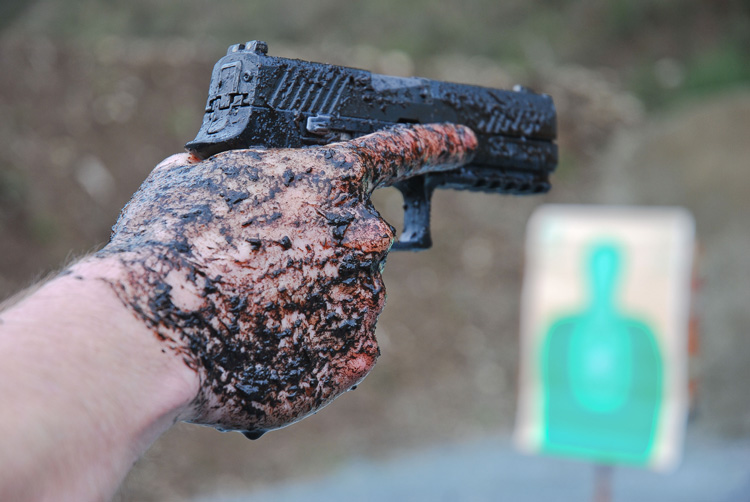
Not entirely satisfied with a purely dry-dirt test, we stripped it, and dunked the parts in wet mud, making sure to stuff filth into every visible crevice. Reassemble, load, aim, press. Bang. As before, the P320 cycled perfectly. The only downside was my face getting plastered with mud from the reciprocating slide.
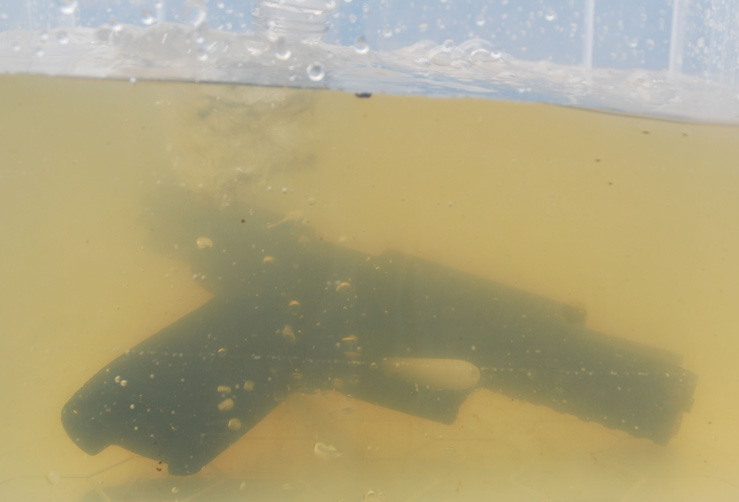
 Finally, we gave the SIG a shower to remove most of the mud and sand, and then submerged it in murky pond water. We shook out all the bubbles, and let it soak for several minutes. Then load, aim, press… Click. A brief investigation discovered that the striker channel was totally water-logged and had delivered a light primer strike. I shook the water out, chambered a fresh round, aimed, pressed. Bang. No more light strikes.
Due to the P320 currently being my main go-to pistol, I chose not to barbeque it or drag it behind my Jeep - a decision which goes somewhat against the grain of a true Calibre review – and I hope you can forgive me. But despite the lack of flames and road rash, we were suitably impressed by the P320. I can confidently say that this is a very reliable firearm.
3 – Simplicity
The KISS principle has been hammered into me since my first days as a soldier. I like simple. And there aren’t many handguns as simple as the P320.
 The controls are kept basic. Like many modern striker-fired handguns, the internal safety systems rule out the need for an external catch, which is great. You either press the trigger, or you don’t.
Stripping the P320 is, perhaps, the easiest of any handgun on the market. Safety was on the top of SIG’s priority list here; you cannot strip the firearm without first removing the magazine and, unlike most other striker-fired handguns, you don’t need to press the trigger.
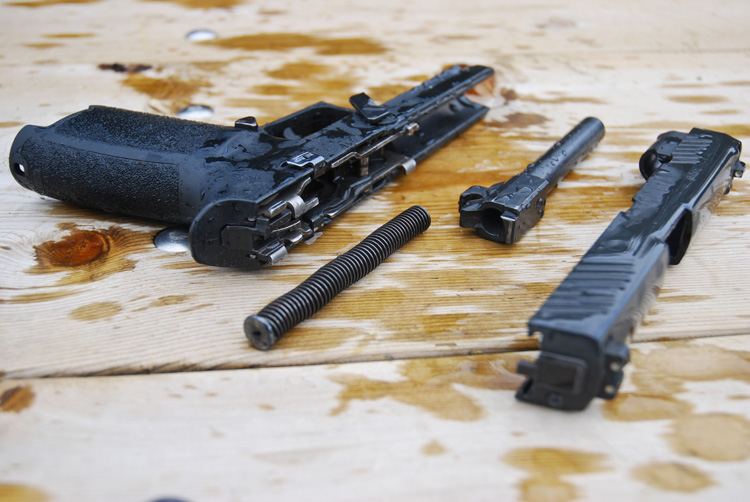 The initial field strip is fairly standard: once you’ve PROVEd the firearm safe, lock the slide to the rear, rotate the takedown lever, and then strip the slide off the front of the frame. The metal guide rod, and captive recoil spring, can be popped out, and finally the barrel can be lifted up and out of the slide. And that is probably as far as most shooters will ever need to go. But what about if one were foolish enough to deliberately stuff mud into the complicated bits? Easy; you take them all out!
We’ll start by removing the Fire Control Unit (which is the serialized part of the gun) from the polymer frame: pull the takedown pin out of the frame and the FCU will lift up and out. We’re not done yet; mud is bound to have found its way into the striker channel and extractor assembly too, so we might as well remove those while we’re at it: using the corner of the takedown lever, press in the extractor spring guide on the back of the slide, and then push the rear slide-cap down and out. Now you can pull the striker assembly, and extractor spring assembly, out of the slide. Finally, flick the extractor out of its home on the back of the ejection port. Done. There’s nowhere left for mud to hide.
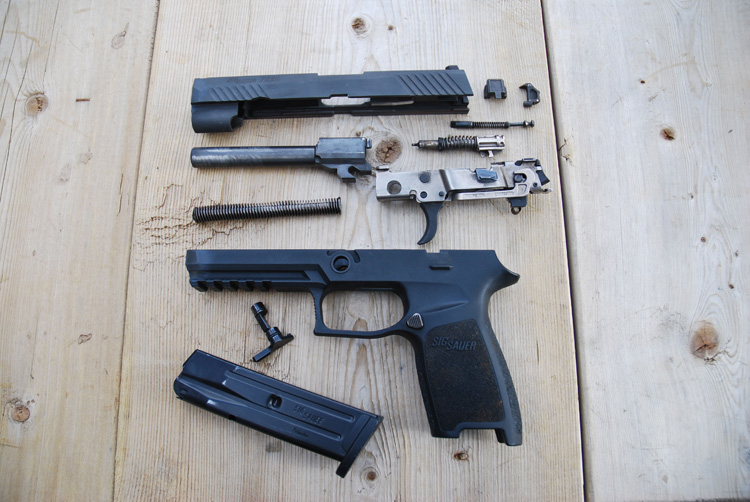 Even without rushing, the P320 can be field stripped, including removing the FCU, striker and extractor assemblies, in about 20 seconds. In the dark. Without tools. Couldn’t be simpler.
4 – Ergonomics
Ergonomically speaking, all semi-automatic handguns are pretty much the same. True, they all have slightly different grip angles, grip shapes, and bore axes; buttons and levers can be different shapes, and are located in slightly different places. But, fundamentally, they’re all the same. I believe that if you can shoot one handgun, you should be able to shoot any handgun. Like cars. They’re all slightly different too, but if you can drive one, you should be able to drive them all.
With that said, if a gun is comfortable, and if the controls are well placed, then it’s a welcome bonus. SIG has a reputation for making comfortable guns, and the P320 is no exception.
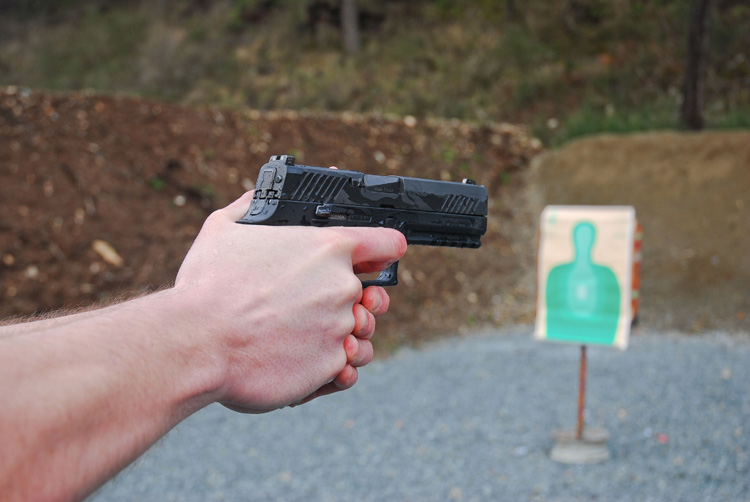 Unsatisfied with changeable back-straps and such, SIG took customization a step further with this new gun, and created changeable frames. The P320 is available with three grip sizes: small, medium, and large, each of which is fully interchangeable without swapping the slide assembly, FCU, or magazines. My medium sized frame, with its rounded, well stippled grip, fits my average sized mitts like the proverbial glove, and should do likewise for 99% of shooters.
The mag release is well placed and easily reversible for lefties. The slide lock is fully ambidextrous, and, despite a few initial problems of my riding it with my thumb, I find its location to be just fine. The mag well is plenty wide enough to easily accept a magazine, even when the shooter is fumbling under stress.
The slide has aggressive serrations, front and rear, and I have never had any slippage when racking, even with wet hands.
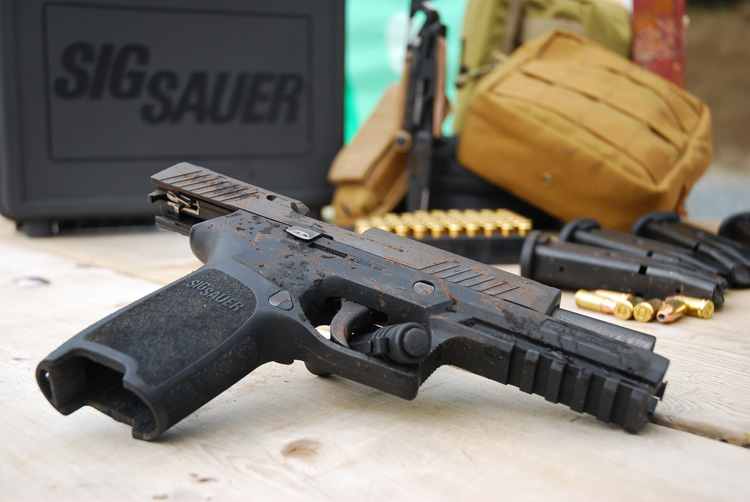 I have heard people complain about the P320’s bore axis. It is higher than that of a Glock. But if that is something that really bothers a person, then either they are very picky, or they need to train more and get over it. The minor difference in bore axis is a relative non-issue when you apply this firearm to practical, tactical shooting.
When the gun is empty it does feel a tad front-heavy; the light-weight polymer frame doesn’t offer the same balanced feeling as an all metal gun. This wasn’t a concern for me for several reasons; one, a slightly heavier front end can help mitigate muzzle jump; two, I added a Surefire X300U to the pic rail which would make any handgun feel front-heavy; and three, because – just like the aforementioned bore axis issue – during realistic, tactical shooting this detail is totally insignificant.
5 – Other Stuff
The P320 has one of the best out-of-the-box triggers of any striker-fired handgun I’ve shot. It is beaten only by Walther’s PPQ, and (maybe) H&K’s SFP9. It is crisp with a short, positive reset, and is consistent at around 7lbs. I also like the fact that it doesn’t have an integral trigger safety like the Walther and the H&K (and Glock); I have never liked how those little levers feel against my delicate finger-tips!
 The much-talked-about modular nature of the P320 has been one of its major selling points. As well as the interchangeable frame sizes, SIG is working on calibre conversion kits which will allow users to buy an extra slide, barrel, and recoil assembly for use with their existing frames and FCUs. The conversion kits are rumored to become available this year in 9mm Para, .40S&W, .357SIG, and .45ACP. This interchangeability makes for a hugely versatile gun.
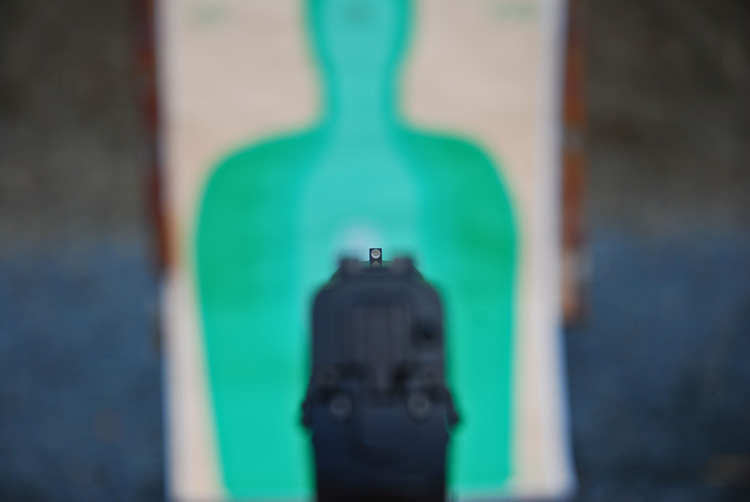
The pistol comes with three-dot SIGLITE Night Sights which are excellent in low light/no light situations. However, when used with a lot of ambient light, they’re not great. The Tritium dots just don’t stand out very well in daylight. In fairness to SIG, I don’t think it’s possible to have open sights which function perfectly in both bright light and the dark. There is always some sort of compromise, and, if we bear that in mind, the P320’s sights are adequately serviceable.
When installing and removing lights, I found the frame’s integral picatinny rail to be a hair too wide. I have tried Surefire, Streamlight, and Inforce lights, and they are all a very tight fit. I guess this could be considered an asset to help prevent them coming loose, but it does make fitting and removal a pain in the backside.
 The overall construction, fit and finish of the P320 is as good as any other SIG. The Nitron coating on the slide has a nice matte finish, and has held up remarkably well, now sporting but a few battle scars. The polymer frame has suffered a bit more from hard use, and now proudly displays numerous minor wounds. All this cosmetic damage is to be expected from a well used tool, and despite these many blemishes, the pistol is far from disfigured. In fact, I’ll go so far as to say that it is even more beautiful now than the day we met.
One final feature of this pistol, which cannot be overlooked, is the price. A SIG for $700?!? – Bargain!
Conclusion
On the whole, I have been impressed with the P320. SIG have indeed produced something special. In a tactical application, I would be happy to bet my life on its performance. In a range application, it’s comfortable and a heck of a lot of fun. I recommend it to everybody.

 SUBSCRIBE TO CALIBRE MAGAZINE
$30.00 / year
SUBSCRIBE TO CALIBRE MAGAZINE
$30.00 / year
 UNAPOLOGETICALLY CANADIAN MEN'S T-SHIRT
$29.00
UNAPOLOGETICALLY CANADIAN MEN'S T-SHIRT
$29.00
 UNAPOLOGETICALLY CANADIAN WOMEN'S T-SHIRT
$29.00
UNAPOLOGETICALLY CANADIAN WOMEN'S T-SHIRT
$29.00