BUSHMASTER ACR DMR: NON-RESTRICTED REVIEW
The United States is the single largest civilian firearm market on earth. And within that market, one rifle reigns supreme: The AR-15. And for good reason. It's pretty much everything you could possibly want in an everyman's rifle. Available in everything from coyote to moose calibres, weighing no more than your average bolt-action rifle, having less felt recoil, providing superb accuracy, and highly modular, it probably is the best rifle of the 21st century. And not surprisingly, because of all that popularity, it's cheap too.
As a result of this momentum, the majority of North America's rifle manufacturers have been relatively recalcitrant to develop new designs that depart from the AR-15 platform, lest they give up ground to a competitor. Hence, we Canadians are often forced to look abroad or to niche markets to find a similarly modern semi-automatic rifle, and oftentimes the things we find end up costing far more than an AR-15 ever would. The Bushmaster ACR DMR is one such rifle.
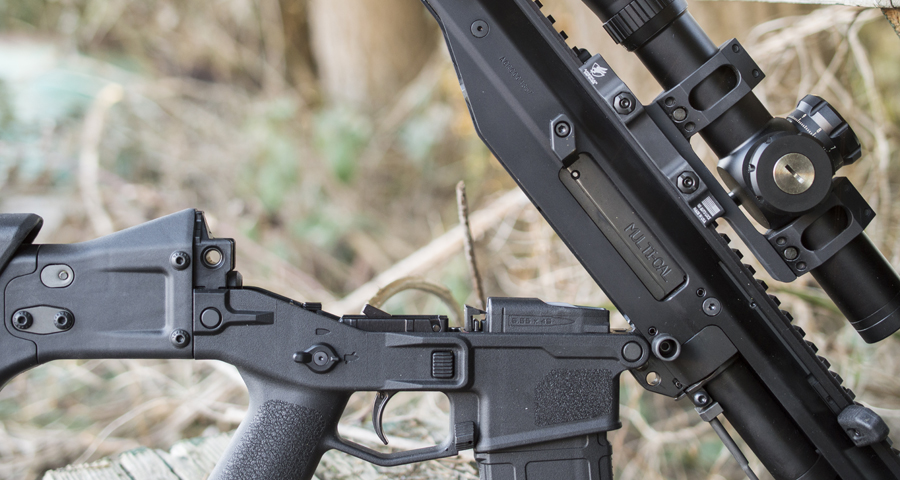 Created by firearms accessory titan Magpul and initially known as the Masada before being licensed to Bushmaster, the ACR has its roots in the early years of the 21st century; when large firearms manufacturers were still optimistic that the venerable M4 would be replaced by a more modern rifle. But, like the AR-15 in the civilian world, the M4 was (and remains) too deeply ingrained in the military machine to be uprooted.
As a result the ACR and its chief competitor, the FN SCAR, were forced to turn to smaller procurement markets for their success… special operations and foreign forces. Unfortunately for Bushmaster though, the SCAR became the preferred non-M4-pattern rifle of most US special operations forces, while the ACR had to go all the way to Poland to find success with the Polish Military Intelligence Service known as the Służba Wywiadu Wojskowego, or SWW. There, the ACR has been so well loved that the Polish firearms manufacturer Radom has commissioned a new ACR-based modular rifle known as the Radom MSBS, for issue to all members of the Polish military.
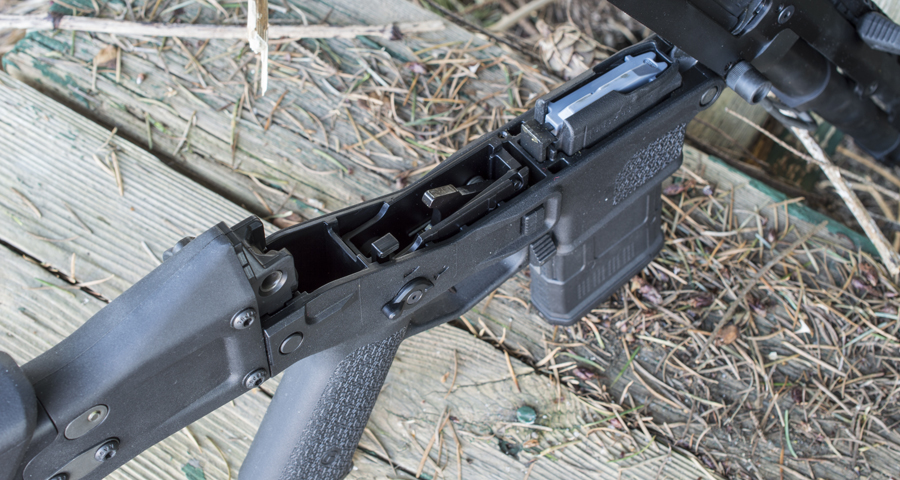 Unfortunately, the relative lack of military success has had a detrimental effect on the amount of attention and expenditure lavished on the ACR, and what was once supposed to be an extensive family of rifles with numerous caliber conversion kits has turned into just a handful of models carrying relatively large price tags due to their rarity. And for Canadians, the frustration has been two-fold, as the ACR platform is non-restricted but rifle availability was limited to models with 16" barrels. As a result all ACRs were restricted upon import due to their barrel length.
That meant anyone desiring to actually own a non-restricted ACR needed to get a new barrel fitted by a Canadian gunsmith; a relatively time-consuming and expensive process. Which is precisely why the debut of the Bushmaster ACR DMR, with a factory-fitted 18.5" barrel, was so compelling when it broke cover in 2014. Unfortunately, again the preference for the AR-15 and M4 pattern of rifles impeded the ACR's progress, and a combination of war efforts in the Middle East and a civilian penchant for ever-more AR-15s conspired to keep the ACR DMR out of production until the fourth quarter of 2016. But it's here now.
What is the ACR DMR?
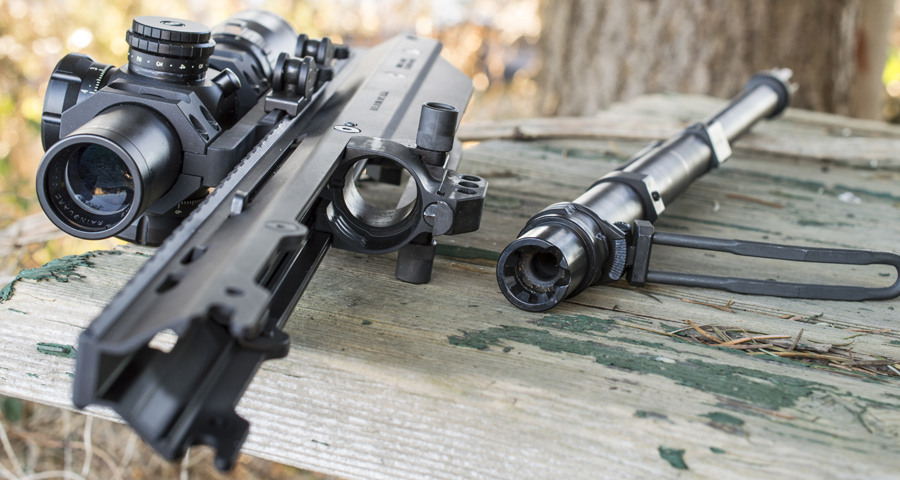 For those unfamiliar, the ACR is a piston-driven highly modular rifle platform utilizing conventional STANAG-pattern magazines, and offering almost unparalleled ambidexterity and flexibility. The rifle itself is comprised of five major components: The stock, fire control group, receiver, handguard, and barrel. Unlike the AR-15, all of these components can be replaced with any other available component in mere seconds with no tools. The receiver, stock, fire control group and handguard are all retained with simple push pins while the barrel is secured to the receiver by a threaded collar. Even torqueing the barrel in place requires no tools, as the barrels incorporate integral folding handles on the threaded collar, which itself is prevented from backing out by a built-in ratcheting system.
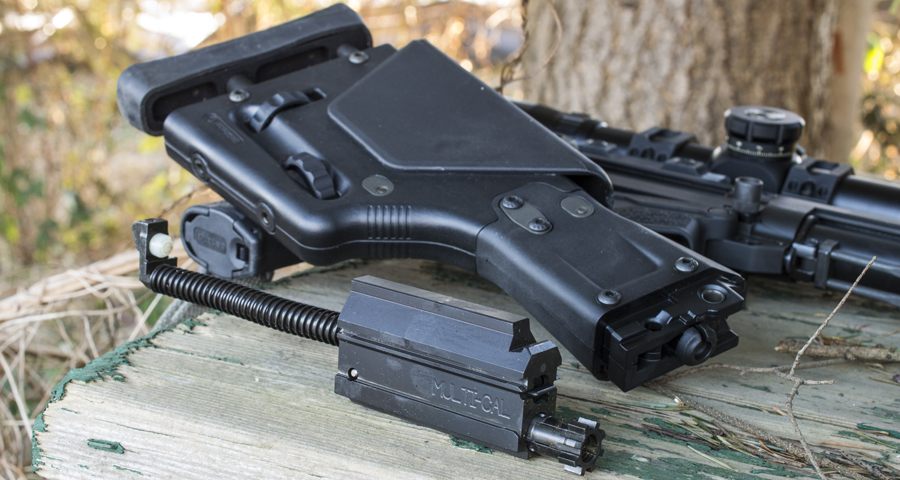
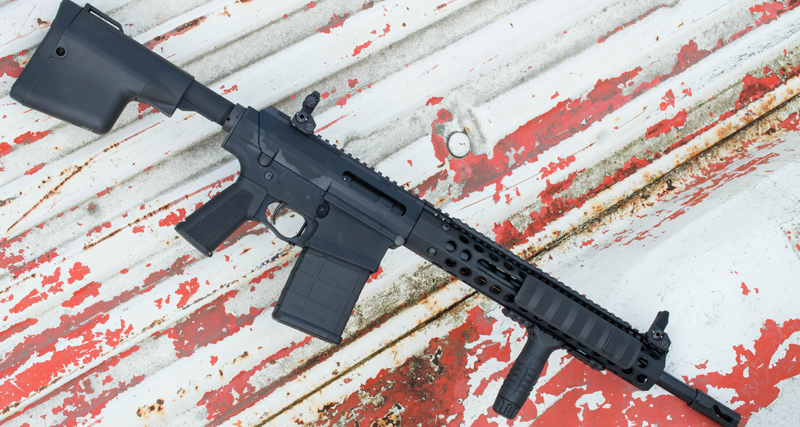
In the past ACRs have been available with either a fixed or folding stock, both of which incorporate particularly brilliantly adjustable cheek risers, while the latter also adjusts for length of pull. The ACR DMR, however, uses a Magpul PRS2 stock specifically designed for the ACR. With threaded adjustments for both length of pull and comb height, this stock allows for fine adjustment in both directions, but sadly does not incorporate the conventional PRS stock's railed lower portion; precluding the use of a stock-supporting monopod.
 Moving forward, the ACR DMR borrows both the fire control group and receiver components from the standard ACR, but fills the former with a Super ACR trigger from Geissele Automatics. A very smooth two-stage trigger with listed pull weights of 2.5 pounds for the first stage, and 2 pounds for the second (for a total pull weight of 4.5 pounds), beyond being a boon to accuracy this trigger's inclusion in the ACR DMR right out of the box is not an insignificant feature: If you were to buy one separately you should expect to pay $400 for the privilege!
Which brings us to the ACR DMR's most important feature; the barrel. Measuring 18.5" long, this wonderful piece of forged stainless steel is notable for a few different reasons, the most important of which is obviously its fulfillment of the Canadian firearms act's requirement that non-restricted semi-automatic rifles possess a minimum barrel length of 18.5 inches.
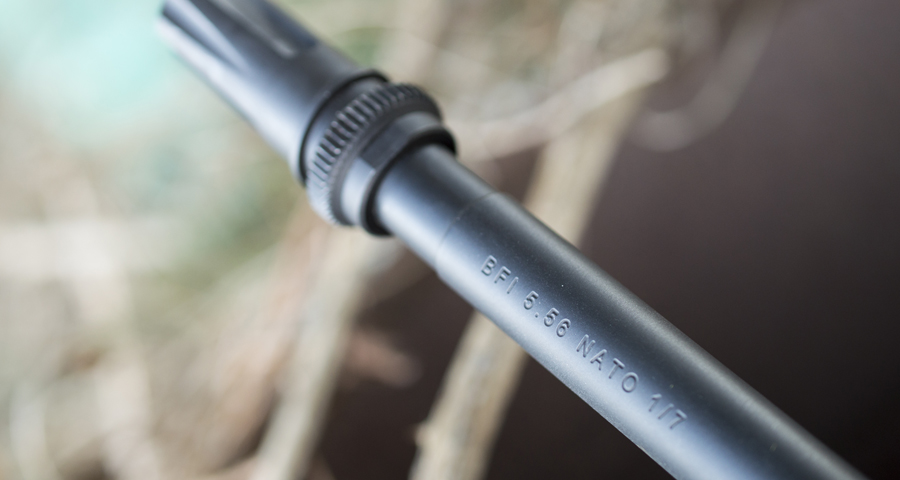
But there's more to it than that. First off, it's heavy… almost ridiculously so. Measuring 0.98" across from the breech to the op rod guide, 0.90" to 0.85" between the op rod guide and the gas block, and 0.73" from the gas block to the muzzle device it is one of the heaviest barrel profiles you'll find on such a rifle. Also, although the bolt is marked "multical," that beefy barrel is chambered in 5.56 NATO. The rifling is cut to match the current standard for most 5.56 NATO rifles, with a 1-in-7 inch twist rate.
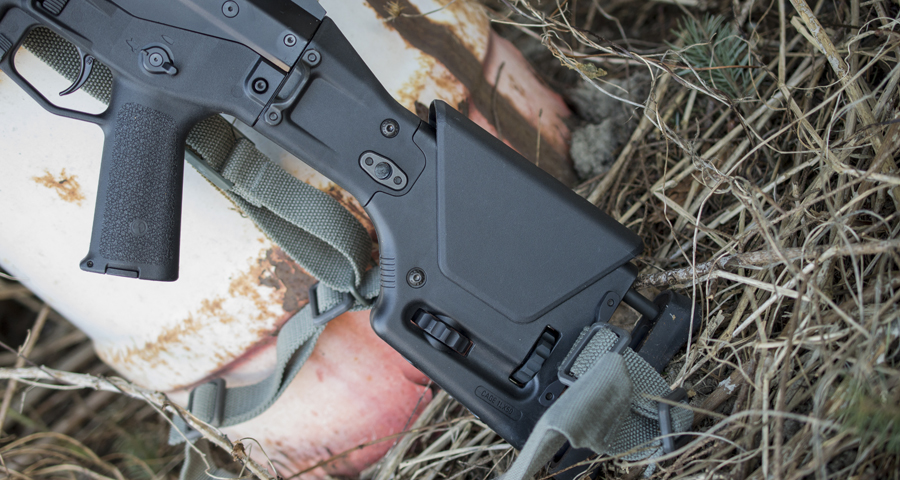 All the aforementioned components can be disassembled quickly, and with no tools. The two pins located where the stock joins the rifle hold the receiver and fire control group to the stock. Pull the topmost pin and the receiver and barrel assembly hinge downward like an AR-15's upper receiver. Slide the lower pin out and the stock can be lifted free. Ahead of the magazine well, the front take down pin secures the fire control group to the upper receiver and barrel, and just ahead of that pin is the pin that secures the handguard to the upper receiver. Pulling that pin and removing the handguard reveals the handle on the barrel that must be pulled down and rotated to unthread the barrel nut and release the barrel. Overall, it's brilliantly designed.
ACR DMR First Impressions
The ACR DMR arrives, like so many other premium Bushmaster firearms, in a relatively staid Bushmaster box containing (in grand Russian nesting doll fashion) a Bushmaster-branded Flambeau rifle case. And inside that is the ACR DMR, safely bagged in plastic, the ubiquitous and always unloved cable rifle lock, and one 5-round Magpul Pmag.
And undoubtedly, the first thing anyone will notice when they pull the DMR out of its case is the overall weight of the thing. Out of the box, sans sling, optic, magazine and ammunition, our test rifle tipped the scales at ten pounds even. As pictured here, with a Bushnell Elite Tactical 1-8.5x24mm optic in an American Defense Manufacturing Recon mount, and a Blue Force Gear VCAS sling, the entire thing weighs 12.5 pounds; definitely on the portlier side of things.
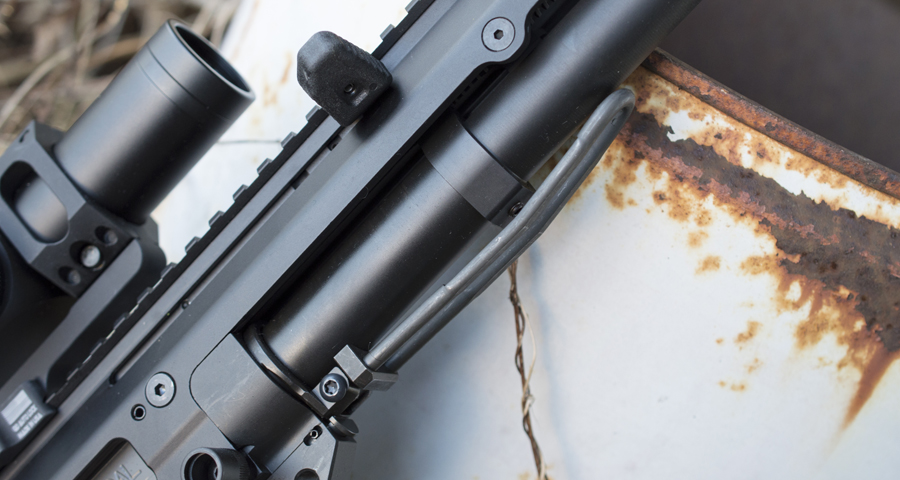 Handling the ACR DMR will feel oddly familiar to anyone that's spend much time behind an AR-15; the pistol grip, safety, and overall dimensions being somewhat similar. But we say oddly because while it feels akin to an AR-15 when you're behind it, there's a few features that we find dramatically improve upon the AR-15 experience. First and foremost is the charging handle. Positioned forward and high on the action like a SCAR's, but being both non-reciprocating and capable of functioning as a forward assist due to its clever design, it comes easily to hand and is easier to work than an AR-15's charging handle. Furthermore, swapping it from one side to another is as easy as depressing a latch atop the rifle with the nose of a bullet, pulling the handle out and re-inserting it from the other side. We just wish the handle itself were slightly larger.
Likewise, we also love the controls for their similarly well-thought out nature. The bolt release is a pair of paddles on the front of the trigger guard; easily depressed by either the trigger finger or a thumb upon reloading. The magazine release is both oversized and ambidextrous. Rounding out the lefty-friendly nature of the ACR is an ambidextrous safety.
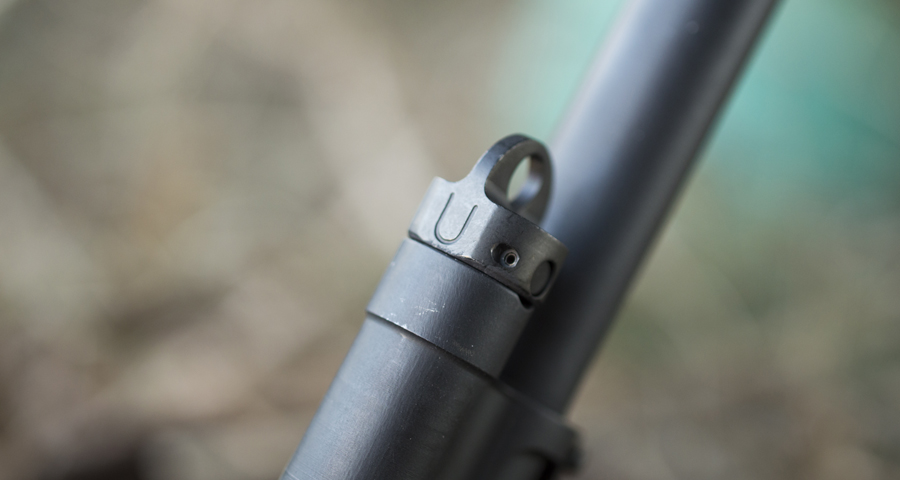
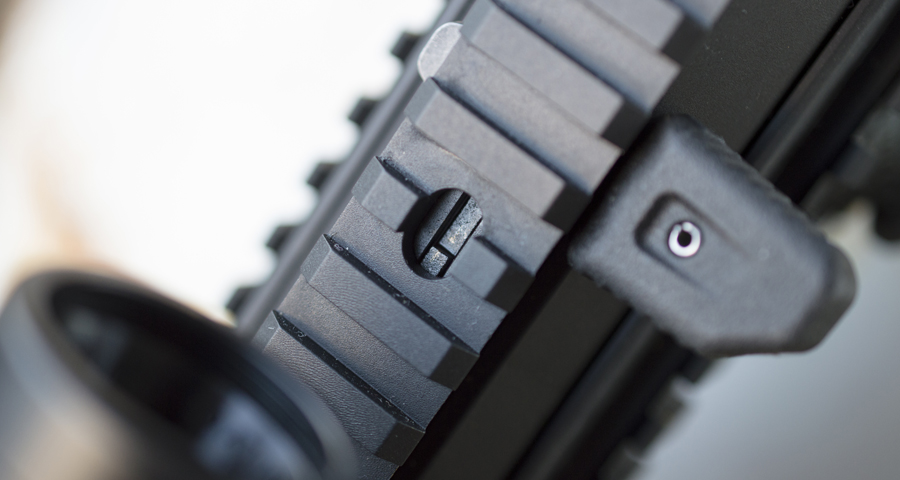 Not surprisingly, for a rifle that's predicated on the notions of flexibility, ambidexterity, and modularity, the ACR DMR also features an almost ridiculous number of small, but useful additional features. First off, the pistol grip contains a secure CR123 battery storage tube. The grip panels cast into the pistol grip and magazine well are actually tiny Magpul logos superimposed on a pebbled texture and are wonderfully grippy. The gas cylinder is capped by a regulator that allows the used to select the appropriate gas setting for unsuppressed or suppressed operation (dare to dream, right). And the rifle has no less than seven sling points baked into its design; five quick-release sling points and two fixed sling points on the stock that can be swapped from one side to the other as the owner sees fit. Interestingly though, on our test rifle, the two quick-release sling points fitted to the fore-end were installed backwards; a problem easily rectified with five minutes and an allen wrench.
Likewise, we also must mention that although the charging handle is in a fantastic position in terms of manipulation and leverage, it does travel through a not insubstantial amount of space on the handguard. In fact, we had initially mounted our optic in a standard-style mount, but the forward scope mount clamp did not allow enough room for us to cycle the charging handle fully rearward. Also, although we've not installed any such devices, we suspect things like PEQ-15s, lasers, and lights would all restrict either access to, or movement of the charging handle.
Shooting the ACR DMR
Now, it's at this point that we must point out that this is a non-restricted black rifle, which already makes it one in a relatively small subset of rifles, but the ACR goes even farther by being a very specialized rifle; it isn't called a DMR for nothing. This is intended to be used in the role of a designated marksman's rifle. Hence the heavy, but accurate barrel and heavy, but adjustable stock. We did most of our testing off either a lead sled when trying to test the rifle's mechanical accuracy and off a shooting bag for the rest of our testing. It's not something you're going to want to run around doing drills with and holding in an offhand position for long.
But if you're looking for something that will allow you to take advantage of the limitless ranges at which you can shoot on Crown land… well, this may be your rifle. Perched atop our well-seasoned Vertx range bag (which makes an excellent rifle rest, by the way) the ACR DMR was a treat to shoot. The Magpul PRS is a fantastic piece of equipment, and with its adjustable length of pull and comb height allowing us to get comfortable behind the gun, we were able to string together groups of comparable size to those that we shot off the lead sled. And that's a good indication of the rifle's sort of intrinsic performance insofar as how well it marries man and machine.
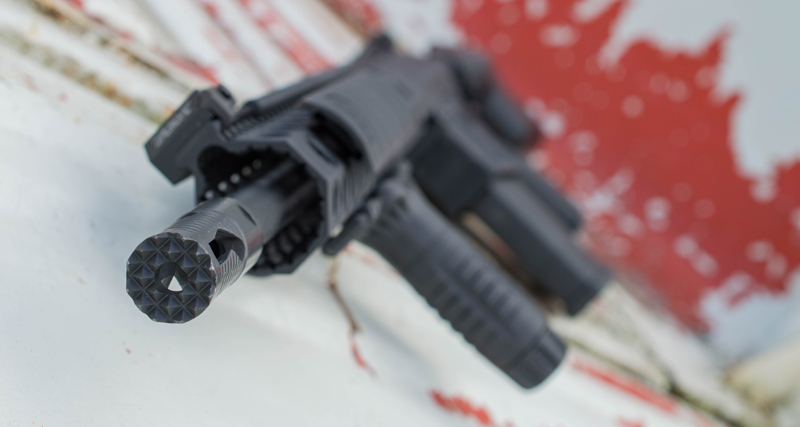
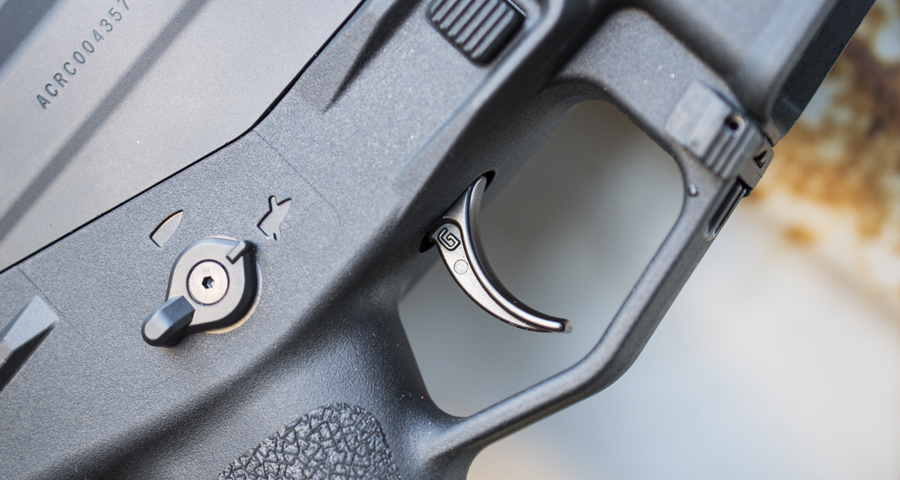 Furthermore, the level of comfort the rifle provides and its weight both make shooting not only easy, but pleasant. Although we (sadly) can't stick the appropriate AAC suppressor on the AAC 51T flash hider/suppressor mount, the 18" barrel does a reasonable job of quelling as much of the 5.56's report as possible… and moves it farther from the shooter's ears. The Geissele trigger is, in a word, excellent. We've always been partial to good two-stage triggers, and this is a good one; there's a tiny bit of creep at the beginning of the second stage but it's barely noticeable and will probably go away with more use. The pull weight is ideal. The first stage is light but positive; you know you're pulling through it and the beginning of the second stage is definitely not something you'll notice. In other words, it's like all good two-stage triggers in that it takes a small degree of effort to get through the first stage, and a similar amount of effort to break the second stage. And the reset is very positive, and long enough to get you right back to the same position as your first shot was taken from… and as we all know, consistency is the key to accuracy. On the other end side of the coin, the trigger's not so light nor effortless that we were ever concerned that we'd pull a shot off before we expected it; there's a reason 4.5 pounds is generally considered the sweet spot for accurate but practical trigger weights.
 Speaking of weights, there definitely an upside to the rifle's not insubstantial weight. Weighing as much as a .308 but only shooting 5.56 means there's almost no recoil, so watching bullet trace and impact is much easier than on a lighter rifle, which in turn means more accuracy.
Overall, the impression of shooting the ACR DMR is one of capability; the rifle's so easy to set up and shoot that you can concentrate on your shooting technique. You needn't adopt an unnatural position to get behind the gun. You needn't break your shooting position to load the next round. You needn't anticipate any significant recoil. You don't even need to remove your hand from the grip to operate any of the controls, regardless of if you're right- or left-handed. Simply concentrate on breathing, trigger control, and sight picture.
In terms of reliability and performance, the ACR has proven to be one of the most reliable rifles we've ever tested; it's literally never not worked. Now, in all fairness, we've had other rifles that have proven to be 100% reliable… but we've never shot a rifle with as many different varieties of ammunition or magazines as we have the ACR DMR.
 We've also never shot a rifle in any many varied conditions as this rifle. From 10 degrees above zero and dry to -15 and snowing, it's fed no less than 8 different kinds of magazines through it, with well over a dozen different kinds of .223 and 5.56 ammunition and it's done it everywhere from clean gun club shooting benches to dirty, muddy, snowy back roads. So when you consider all those variables, it's pretty impressive. In the two short months that we've been testing it, the beefy Bushmaster has given us utter confidence in its reliability, and we expect it to continue to do so.
But if we're honest, we expected as much from the ACR DMR; being a premium piston-drive gun there's no reason to think it'd ever choke. But the ACR doesn't have the best reputation for accuracy. Due to the nature of its quick-change barrel system, it's hard to manufacture such a rifle on a large scale and do so with a high degree of accuracy, and most ACRs are known for being "battlefield accurate." In other words, 2-4 MOA, or perhaps slightly better. The DMR is not like other ACRs though, evidently.
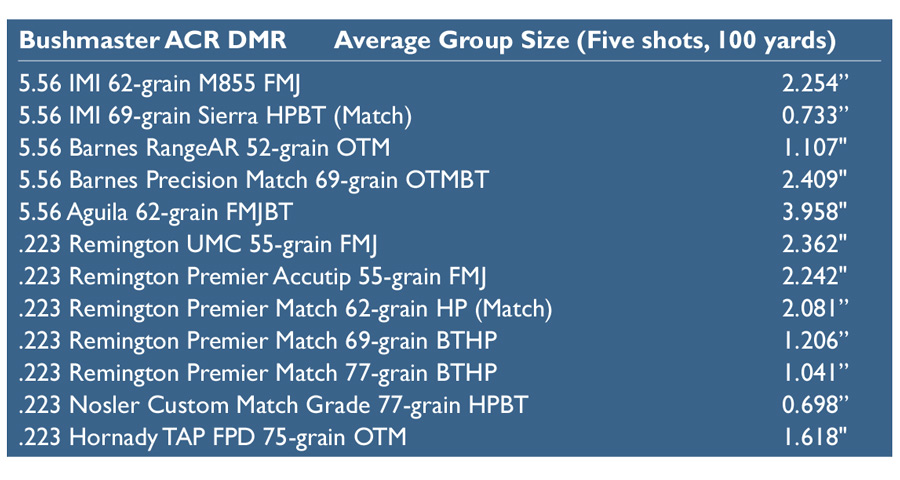 Although accuracy with many of the bulk ammunition varieties typically ran around 2 MOA, the DMR responded very well to ammunition that makes use of the barrel's fast twist rate. Longer, heavier bullets ranging in weight from 69- to 77-grains typically worked well, as did the newer forms of factory ammunition specifically directed at semi-automatic rifles with faster twist barrels, like Barnes' lead-free 52-grain zinc-core RangeAR ammunition.
Conclusion
The Bushmaster ACR DMR is many things. Accurate, reliable, heavy, and expensive. But it's also rare. As previously discussed, ACRs remain a relatively uncommon rifle in all circles, and with only 100 ACR DMRs having come to Canada in the first shipment these particular rifles are unlikely to ever become common.
And although Bushmaster's importer, Gravel Agency, is looking forward to additional shipments throughout 2017, the combination of the rifle's niche appeal and $3,399 retail price relegate this rifle to somewhat exotic status.
But if you happen to be in the market for something non-restricted, that's not only capable of, but rather particularly well suited to longer range shooting, this is a great rifle. So great, in fact, that we lightened our own wallet in order to purchase the rifle pictured here. That makes it 99 out there and counting for now...
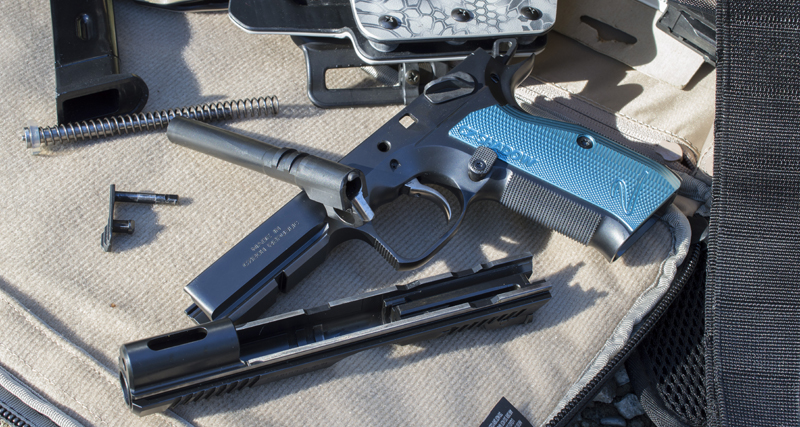 Fast forward through the end of a superpower, the total collapse of an entire political ideology, and the end of the Cold War (see our article on the 10mm Auto for details as to how this occurred) and the CZ-75 found itself reinvented as a competition gun in the form of the Shadow. Owing in part to the particular rules of IPSC Production class, the Shadow, with its easily massaged trigger weights, readily available factory speed parts, legal-by-grams-and-millimetres design, reasonable price thanks to low Czech labour costs, and similarity to the already-popular Tanfoglio pistols, rapidly came to dominate the Production division. Offered in a bewildering range of variants which we won’t detail because we literally can’t understand them all (but just as a sampling, there’s a Shadow Tac II, a Shadow Mate, a Shadow Line, a Czech Mate, a Tactical Sport, a Tactical Sport Orange which incorporates some of the features of the Czech Mate…and we’re only about halfway through here) the CZ line of pistols has a better eye on competition handgunning than just about anyone. We don’t think they have a model designed to perfectly skirt the rules of every single game, but if they produce a variant designed to win the Glock-only GSSF, that won’t really surprise us.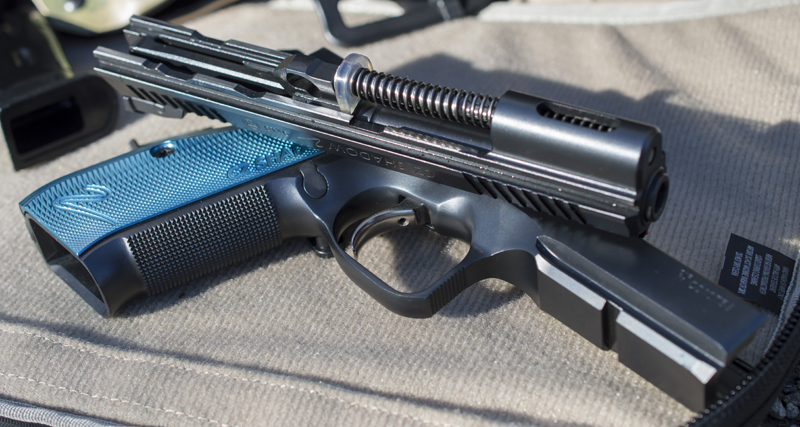
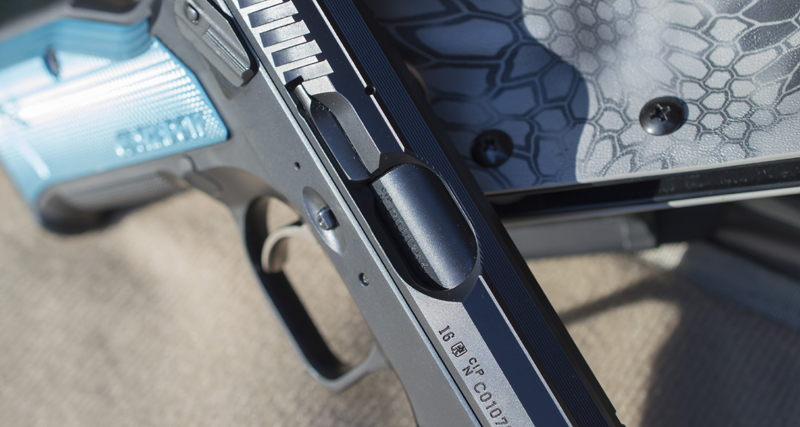
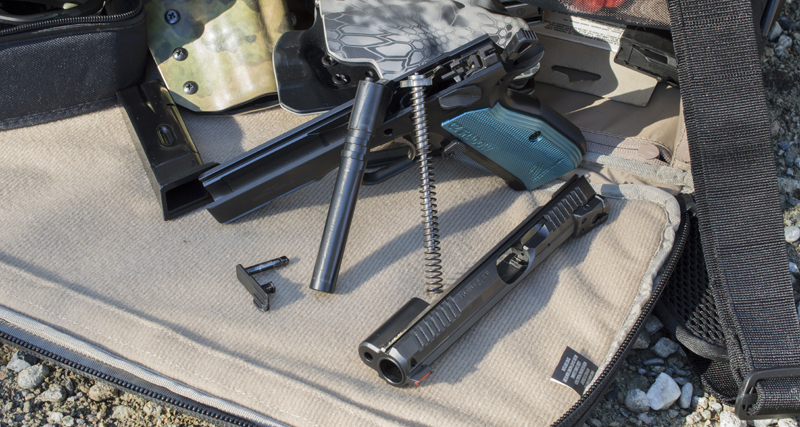 The wider frame also houses the new trigger mechanism, which from feel alone shares more with the Tanfoglio trigger than the previous Shadow trigger. The reset is short but positive and tactile, which is exactly how we like them. The previous Shadow had a good trigger, but this is excellent. Even with the factory spring weights, it’s extremely smooth and easy to shoot with a high degree of accuracy. Most competitors will replace those springs within hours of acquisition; it happens that trigger spring kits from the original Shadow will fit the Shadow 2 although the effects of the individual springs will be slightly different on account of the different mechanism. But for people committed to the original platform, take heart: even your accessories will work, for the most part.
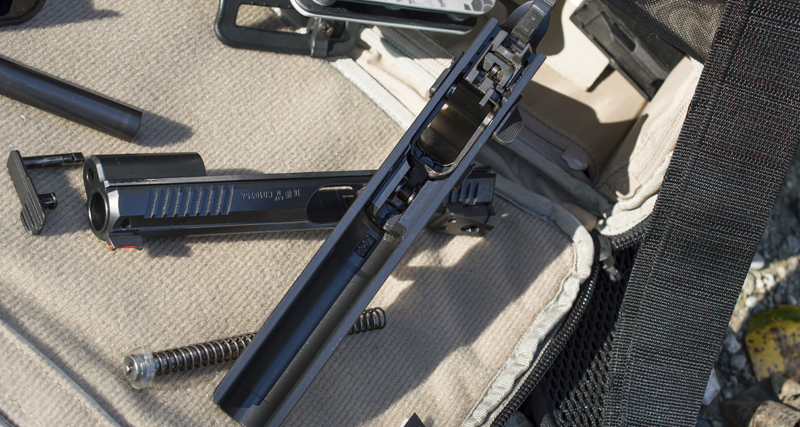 The other quibble we have is not technically a part of the slide, although the slide features one of the most egregious examples: the font they used for the number 2. I mean come on, guys…that font is appalling. We don’t mind if you use it in ads but machining a weird early-90s euro-dance-party 2 right on the slide…that just hurts us. The one on the grips we can cover with our hands but come on guys, the slide?
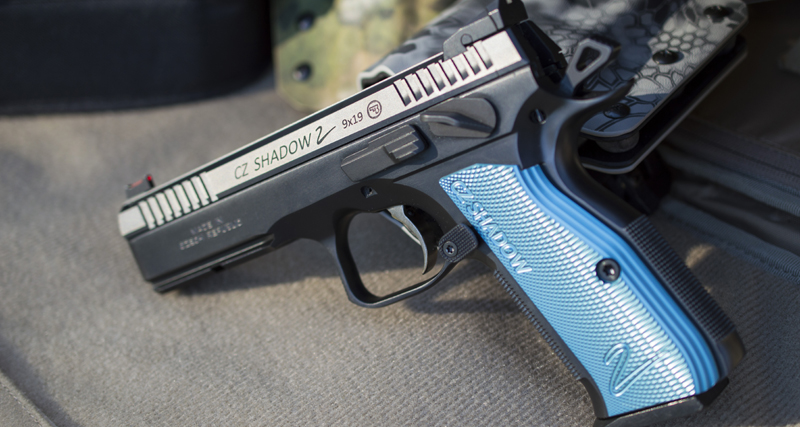 And it just shoots like a house on fire. The recoil is absurdly soft, likely as a consequence of the high grip and low slide mass. The sharp checkering, if you have hands that can take it, locks the pistol into your hands good and hard and you can launch bullets downrange at any speed you feel confident pressing the trigger. The sights, which are an adjustable rear paired with a fiberoptic front, are exactly what you’d expect on a pistol like this. It’s a shooter’s pistol, no doubt about it. The trigger we immediately loved on the bench was great on the range; that short, positive reset makes it essentially impossible to “short stroke” the trigger as one of our staff has done with several guns when moving at maximum speed (that’s what a lifetime of 1911s gets you). It’s the best reset we’ve ever felt on a trigger, in fact: there’s enough push to take your finger well past the sear even though the entire travel is quite small. The actual break is so short that by the time the reset occurs, you’re already having to press back to get to the sear. In an ideal world, this is just exactly what triggers should feel like.
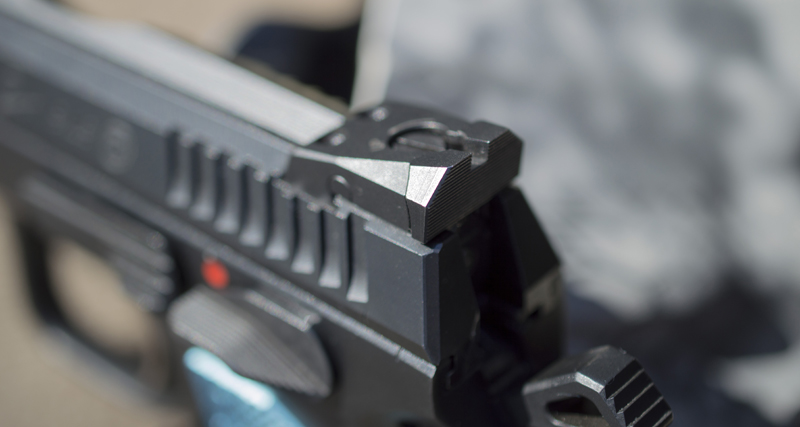 For the sake of thorough testing, we also tried out the thumb safety. Granted, we know perfectly well that nobody is going to use it very much, since IPSC Production class doesn’t require the use of manual safeties on guns with a double action trigger. In fact, many competitive shooters swap the original thumb safety for a flush safety since they’re not using it to begin with, and not only do they not want to accidentally switch it on, but they commonly find it interferes with a high grip on the pistol. So yes, the safety is pretty irrelevant. But it does work, if you want to take the Shadow 2 into a different game that requires using it.
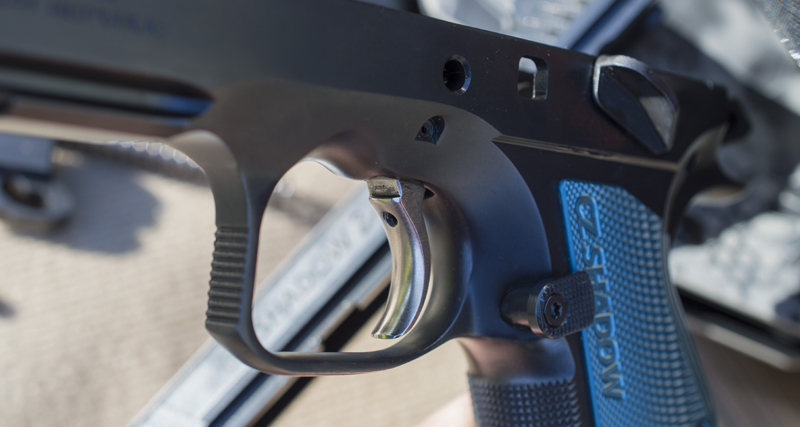 Shooting the Shadow 2 also brought out another difference: the increase in weight (about 150 grams) combined with the new frame and undercut beavertail make recoil management extremely easy. The heavy steel frame soaks up the already mild 9mm impulse, and the extraordinarily high grip that shooters can take advantage of situates the recoil very low in the hand. The small slide which we found difficult to grip was now an advantage: its low mass makes for a very quick, almost “poppy” recoil that hardly upsets the sights. This is simply one of the easiest guns to shoot quickly that we’ve ever seen.
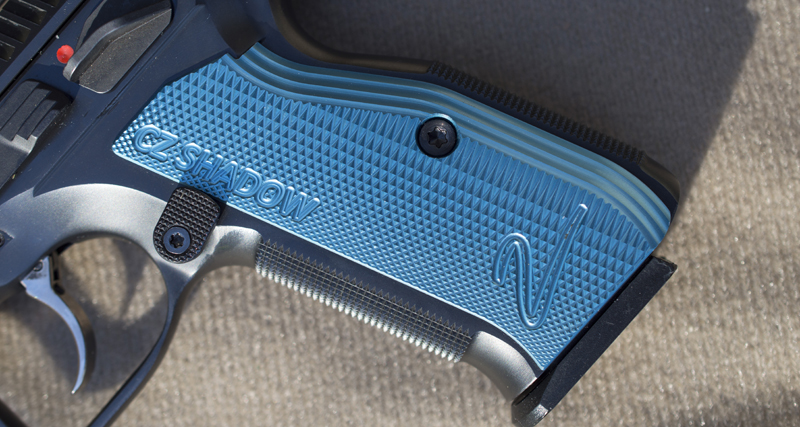 In the end, there’s no way to describe the Shadow 2 as anything but an absolutely superior competition piece. With a street price in Canada around $1400, there is nothing that can touch it. If you’re on the fence about upgrading from an original Shadow, we highly recommend it. If you’re giving serious thought to a competition-ready pistol, this is the gun to buy. If you just want to own the best bang-for-buck hammer-fired steel pistol you can buy, get one. The machining throughout is on par with 1911s costing significantly more and the performance aspect is impossible to ignore. As 1911 and Hi-Power aficionados, it pains us to say this, but if you’re buying a metal pistol in this price range and you don’t buy a Shadow 2 right now…boy, you sure better have a good reason. And you better let us know what it is, because we can’t think of one.
 We won’t spend pages detailing how semi-automatic guns have been popular for hunting use since the Browning Auto-5, which is over a hundred years old. We won’t obsess how the most popular hunting rifle in Canada for most of recorded history was the lightest, fastest, highest-capacity military rifle we could get our hands on, the Lee Enfield. We won’t derail this review with our frustrations about how elsewhere, the AR-15 is now among the most popular hunting rifles ever built, and is simply another link in an endless chain that sees yesterday’s military and police technology filter down to sporting hands because it’s quality technology that succeeded in the first place because it works well, and that fear-mongering about a rifle on the basis of its appearance is just silliness.
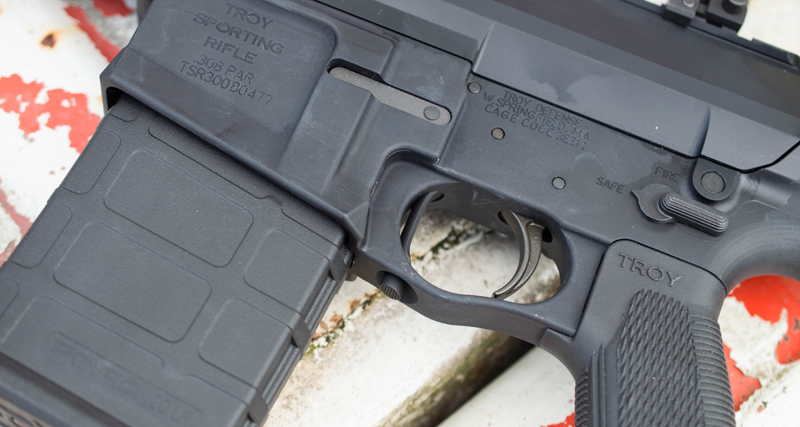
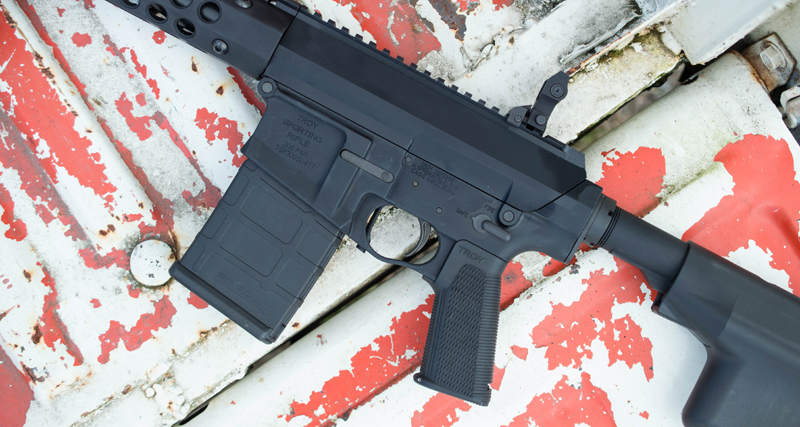
 At any rate we can’t all live in places where the most popular sporting rifle of our era is legal to take into the bush. The same conditions are endured by millions of our American cousins as well, and while we’re hardly happy about that, the one upside is that the market for “workaround” guns is actually fairly large. And that’s exactly what the Troy PAR is: it’s a workaround for people who are (or would like to be) heavily invested in the AR platform, but who are coping with a legal restriction relating to its design. In some cases, the problem is the semi-automatic action; in Canada, it’s because our legislators wrote the name down on a list of random guns that looked scary. Either way, the PAR solves a very specific problem: what if you really want to use an AR in the field, but you’re not allowed?
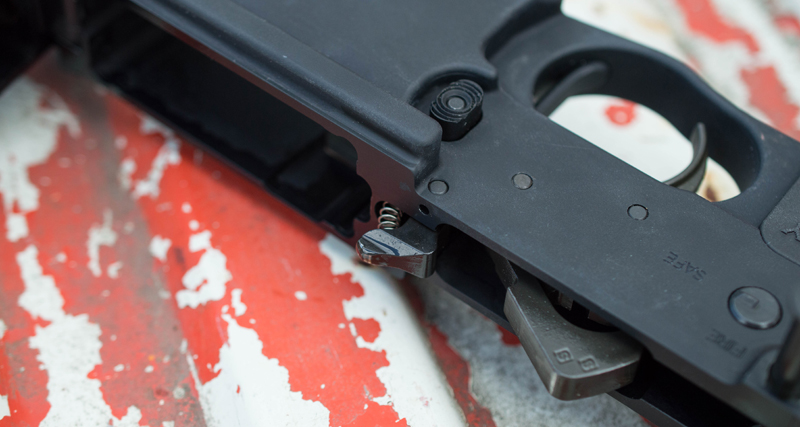
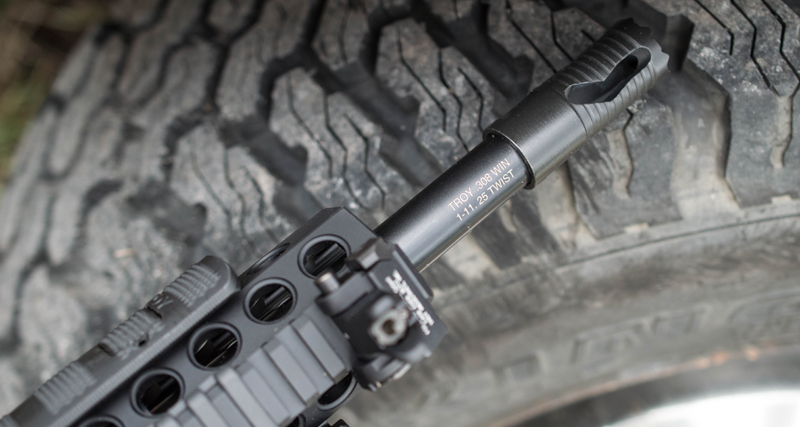 Inside, the Troy PAR continues its menu of AR parts: the trigger group is pure AR and can be swapped out for any standard AR trigger; the bolt carrier is very slightly modified to handle an operating rod in place of a gas key but the bolt is an AR bolt. The barrel is almost an AR barrel, although obviously it has no gas port, but in theory at least, a different AR barrel could be dropped in after the gas port was soldered closed (or before it was cut, if that option is available to you) as long as the diameter is small enough to allow for the action ring to travel around the barrel.
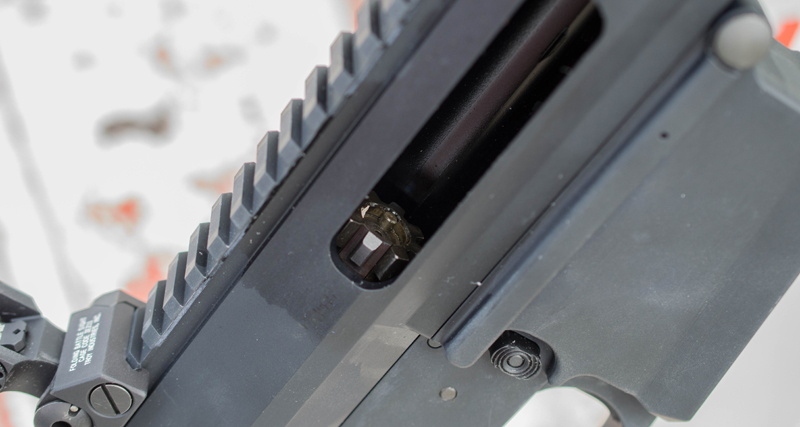 Seeing the Troy PAR’s pump action work is interesting. The slide itself travels on the slots cut into the rail; the design is extremely rigid and operation is fantastically smooth. The PAR is essentially turned into a manual long-stroke piston gun, the operating rod taking the place of the standard gas tube. The bolt lockup is, of course, exactly like a standard AR, and offers the user an interesting, if somewhat academic, insight into the incredible design of the original Armalite: with no spring tension on the action and a more natural grip than that afforded by the AR’s charging handle, it’s possible to feel just how smooth the operation of an AR-type rifle really is. Answer: spookily smooth. We had to look inside with a flashlight just to convince ourselves the bolt really was rotating into lockup.
 So we loaded up the Enterprise with brass-cased .308 and headed to the range. And we were not disappointed.
 On top of that, there was no detectable distortion of the brass. Not with 147 grain mil-spec stuff; not with 175 grain match ammo, not with anything in between. Whether this holds true across the board for every single chambering, would couldn’t say, but we’d guess that at the very least, the .308 and .223 versions will not have issues, because pressures in .308 are typically higher and the geometry of the chamber is such that the larger round will have more unsupported brass. If the .308 works fine (and it does, in case that’s not clear) then the .223 should work just as well. We’re chalking the poor extraction theory up to more internet rumour-mongering.
 The other notable feature of this rifle is its accuracy. In some ways this shouldn’t have been as surprising as it was: functionally, this is basically a high-quality AR-10, with fewer moving parts at the time of ignition. It’s a little more challenging to shoot offhand for repeatability so if you’re really interested in shooting target rifle from a standing position, this may not be your thing for the simple reason that the motion of racking the slide is a little disruptive to an ideal target stance. But this isn’t a target rifle, it’s a brush gun with the accuracy of a target rifle. Using the Federal Gold Medal Match, we found it to be the equal of many bolt guns we’ve used, and with generic Winchester White Box and Federal XM80 (which is essentially factory seconds of Lake City M80) it would still turn in easy two inch groups when shot unsupported from a bench. The free float rail allows the use of a rest or even bipod if you want to really maximize your accuracy, but the bottom line is that this rifle is unlikely to be a significant hindrance in accurate shooting. We were amazed with its performance at 100 yards. The 1:11.25” barrel seemed to really like the 168 grain Hornady A-max loads, incidentally, although performance at the limits of our personal shooting abilities are difficult to chalk up to ammo alone. But if you want to wring accuracy out of one, we’d start with the A-max or Federal Gold Medal Match.
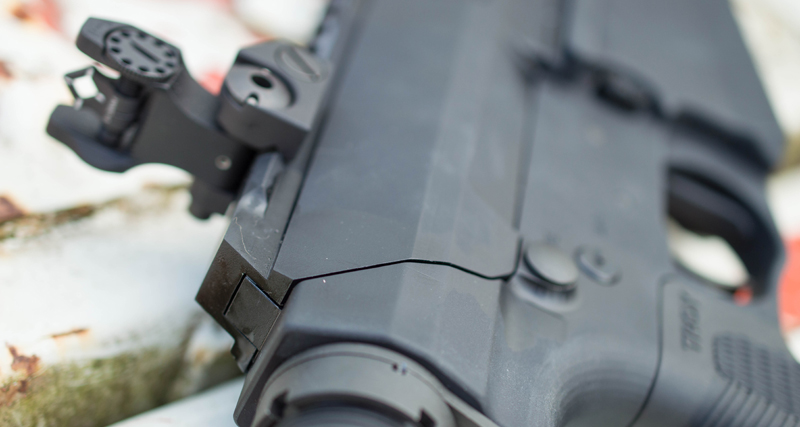 Whether the Troy PAR works for an individual shooter or not is difficult to say. There are a few non-restricted black rifle options in Canada, although nothing this close to the AR platform is readily available, and at the price point it’s being offered, nothing can touch it: the .308 optic ready edition is barely over $1100, and the .223 edition starts a penny shy of a grand. These are extremely well-built and smartly engineered rifles for that money, and if you’re looking for a compact, high-performing brush gun that’ll drop jaws in hunting camp, plus drop targets at any range you feel comfortable attempting, this is your rig. In particular if you’re invested in the AR platform, as so many of us are, we think this gun has a lot going for it. Sure, there will always be people who don’t want to see black guns in the bush, and at the other end of the spectrum people for whom a manual-action rifle is somehow an affront to their beliefs. That’s fine. For the rest of us, tragically mired in the reality of Canadian gun laws, and looking for a solution to the non-restricted black gun conundrum, well, this is established, proven,Troy Defense quality, reliability, and durability, and you can take it in your truck wherever you want to go. We’re calling the Troy PAR a solution par excellence.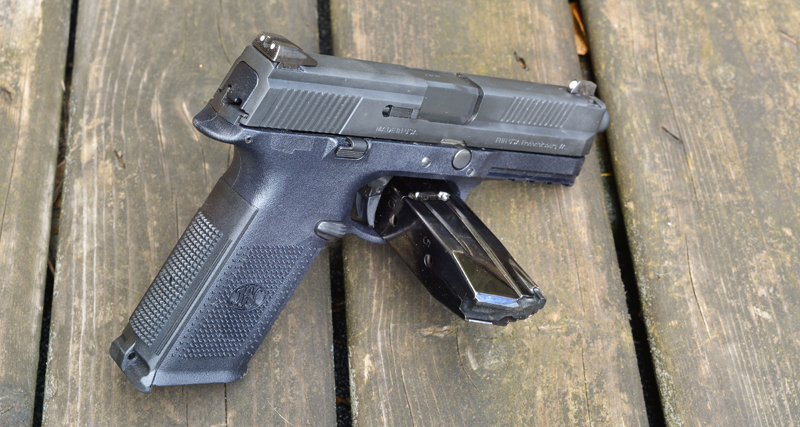
 Tears dried? Stiff drink poured? Okay, let’s mourn the loss of the FAL by doing something positive: let’s celebrate the living. FN Herstal, of course, didn’t go anywhere. They kept right on building some of the most legendary arms in the world. Not only did the FAL and Hi-Power remain in production, but FN’s significance in the military arms trade is truly remarkable. The M249 and M240B light and medium machineguns, not to mention the M2 .50BMG machinegun for when you actually need to erase the fabric of reality itself, are all FN products. The Euro-exotica P90 and the American M16 service rifle, both built by FN. In many cases they compete with other manufacturers who build the same guns under license, so we’re not claiming they’re the sole source of every single gun they make, but no matter how you slice it there is no way to conclude that the Belgian powerhouse is anything but a world-class manufacturer of firearms.
 Frankly, it’s probably more of a timing issue than anything. It’s often the case that the first product to market owns the lion’s share of it; at the very least, it becomes the standard to which all other products are challengers. A certain Austrian company got in while the getting was good, and everyone else is playing catch-up against a gun that dominates the market with 80% of law enforcement sales; there’s no way around it. And if you have a multi-decade head start with a popular product, it’s a tough fight to get your product out. The aftermarket support isn’t built in; accessories aren’t as readily available. You’ll fight for every inch of market share.
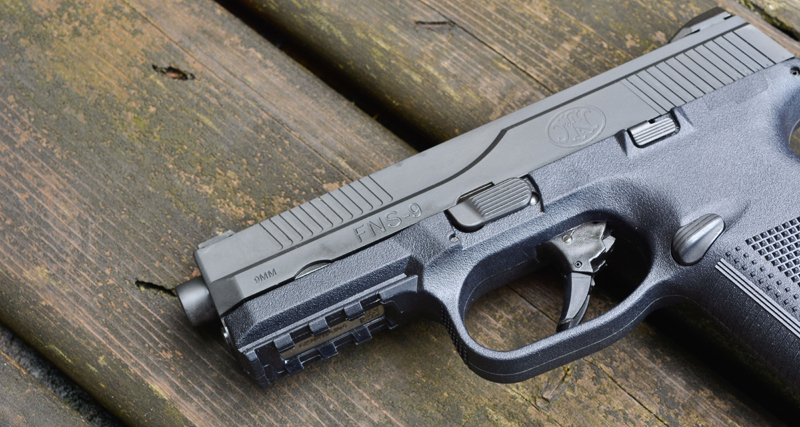
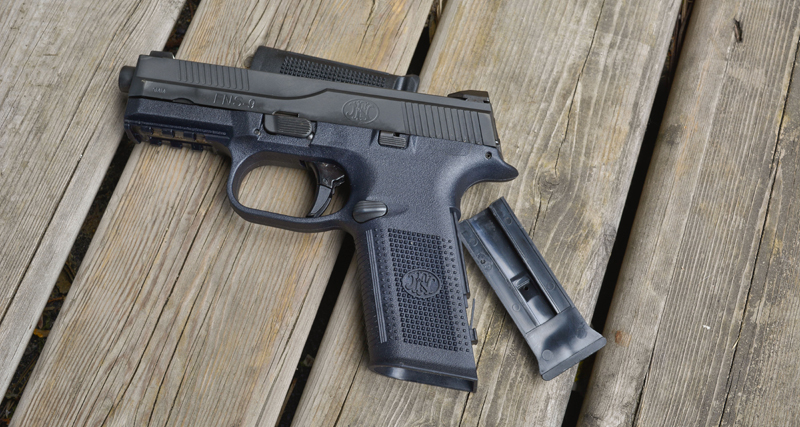
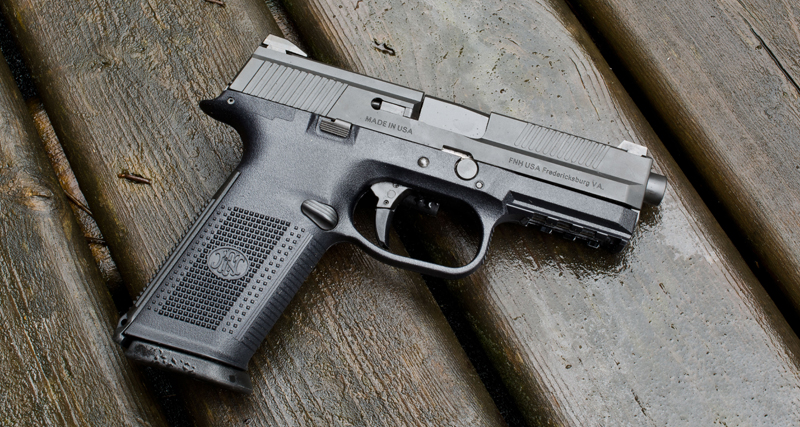
 And this review will be perhaps shorter than we’d like, because the real excitement is yet to come, as we subject the FNS-9 to a long-term test of thousands of rounds. In that testing, we hope to illuminate some of the features in detail, so for the moment, let us simply say that the FNS-9 is a classic striker-fired, polymer framed service pistol that stacks up well against anything we’ve seen. The trigger is better than its competitors; the travel is slightly longer than a Glock’s, but the break is noticeably crisper and it has much less of the creep before the break that many users of striker-fired pistols have grown to accept. The factory sights are good enough to keep unless you have a serious need for something particular; they’re three-dot sights with a large front dot and what’s effectively a U-notch on the rear. That rear sight alone is enough to make us think they consulted real shooters for this build. In combination with the trigger, which not only features an excellent break but is physically a well-built part, being a two piece affair that’s polymer but built to be more rigid and less “flexy” than most of the striker-fired guns we’ve seen, and which presents a smooth, curved profile to the shooter, the FNS-9 is truly a shooter’s service pistol.
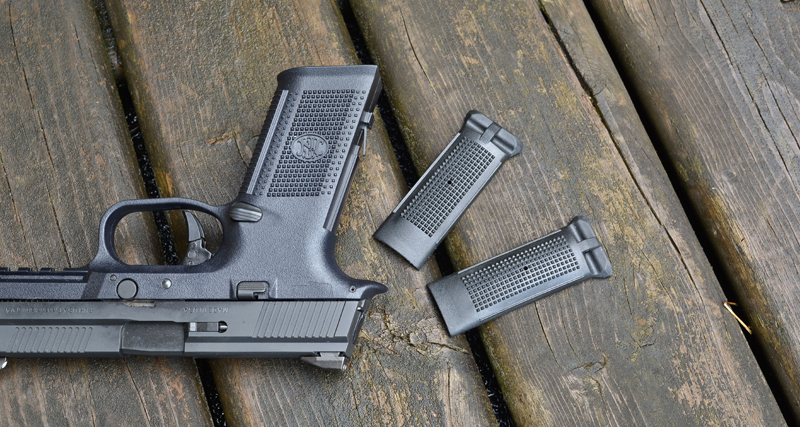
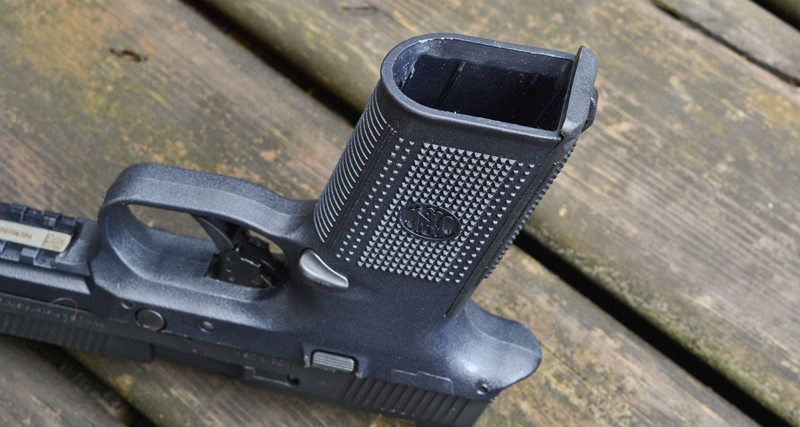
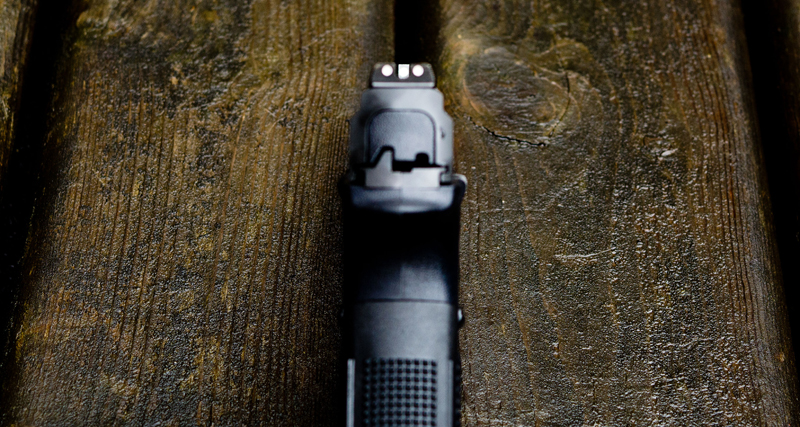 The grip is adjustable, which has become de rigeur for pistols in this segment,and offers enough of a variation that anyone without truly exotic requirements should be accommodated easily. Partly on account of our extensive collection of flat mainspring housing’d 1911s, we switched to the flat backstrap fairly early on into the testing, in spite of the fact that we have size XXL hands. The switch is easy enough: there is a tiny hole in the grip which gives access to a small plastic latch which prevents the backstrap from sliding off. Depress the latch with a 1/16 punch or a finishing nail, and you can slide it down and off the pistol.
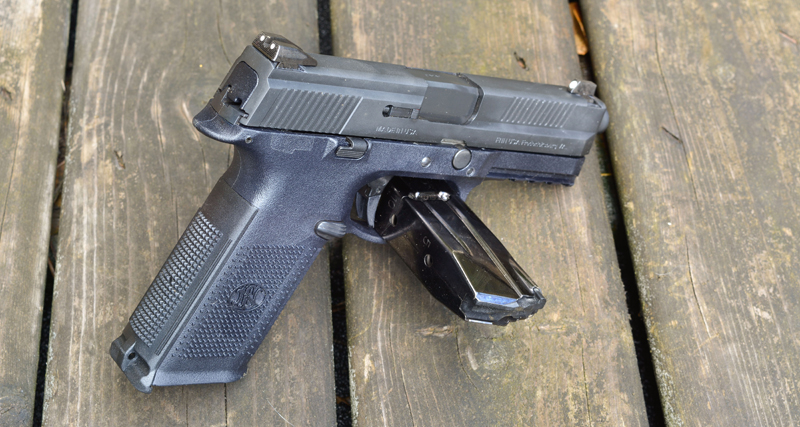 The slide is nicely machined, with forward and rear cocking serrations and perfectly executed chamfers across the board. We realize this is essentially an aesthetic comment, but at the same time, it shows a high degree of attention to detail that we can’t help but like. It’s easy to look at this pistol and see where the money is going. Gripping the pistol and drawing the slide back, it clears the user’s hand by a good margin even if an exceptionally high grip is taken, the web of the hand being protected by a generous beavertail.
 But warm fuzzies are not data. Our goal is to bring data to the table, and as such, this article is only the beginning.
 The process to date has been as follows: the FNS-9 was removed from the case, and, in a fit of excitement, fed 50 Blazer Brass and 50 Blazer aluminum with only the initial storage lubricants in place. No malfunctions were noted. Cooler heads prevailed and the pistol was field stripped and a simple mineral oil was liberally applied to all recommended locations, after which the pistol was returned to service.
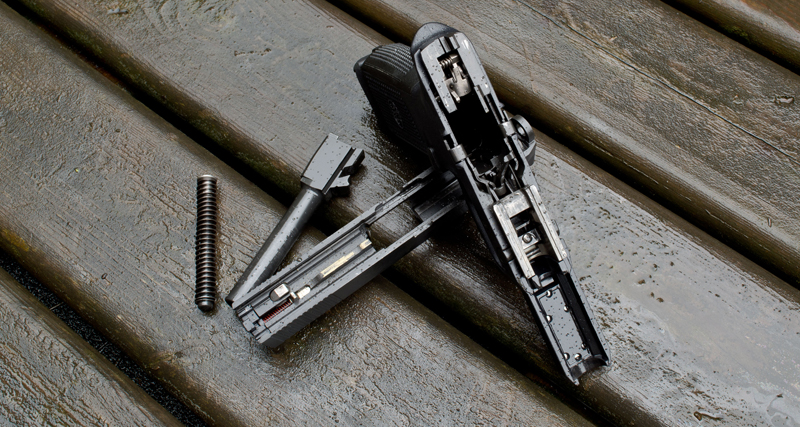 The pistol was field stripped for photos but it was not cleaned and no lubricants were added. It will be shot for a minimum of 1522 more rounds before it is lubed again. No, this is not a good way to treat a pistol, but our early experiences have been so positive that we feel the FNS-9 needs to get subjected to some of the same abuse that its competition have famously endured, because right now, we think this pistol is one of the best-kept secrets on the market.

 Coming from a competitive shooting family with a three-time Olympian father that competed in the shooting sports, Kiejko grew up with a pistol range in her basement, and is now joined by her sister; Olympic competitor (2012 in London) and fellow shooter Dorothy Ludwig. Both Ludwig and Kiejko follow in the footsteps of their father, Bill Hare, who was known jokingly in shooting circles as the Pistol-Packing Preacher. Although Bill Hare passed away from injuries sustained in a car crash in Calgary some 12 years ago, his legacy obviously lives on in both of his daughters, as well as those that knew him.