Believe it or not, we here at Calibre do actually get some hate mail. Obviously enough, it always seems to focus on the editorial direction of our magazine, and typically revolves around the notion that we accept, advocate, and (gasp) even expound the merits of guns like AR-15s, handguns, and sometimes even (double gasp) prohibited things like suppressors and whatnot. And we live with it. Guns are a contentious subject, even among gun owners. But once, just over a year ago, we got our one and only less-than-complimentary correspondence indicting us for even allowing an advertisement to run in our magazine. The advertisement? The announcement of Alberta Tactical Rifle Supply’s then-new, non-restricted Modern Hunter.
See, the notion that there could be a new rifle that shared so much with the AR-10, but was classified as a non-restricted firearm was such an unlikely, outlandish notion that at least one person out there thought the mere act of advertising such a rifle as non-restricted constituted an act of fraud. Now, unbeknownst to the individual in question, we fact-check as much as we can with our own sources and we did know the rifle’s pending status, but nonetheless it speaks to the innovative audacity of the Modern Hunter’s design.
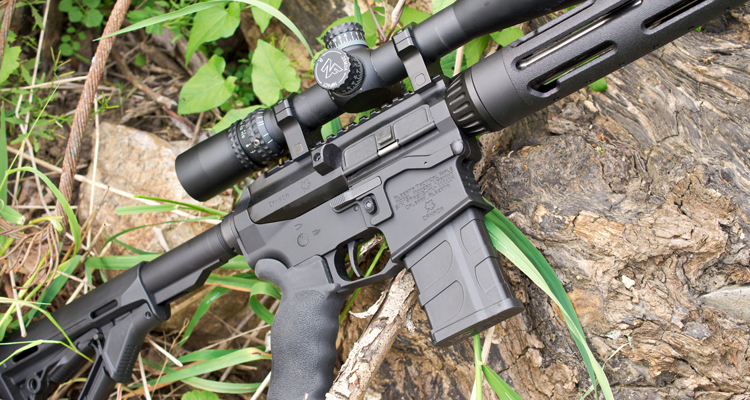
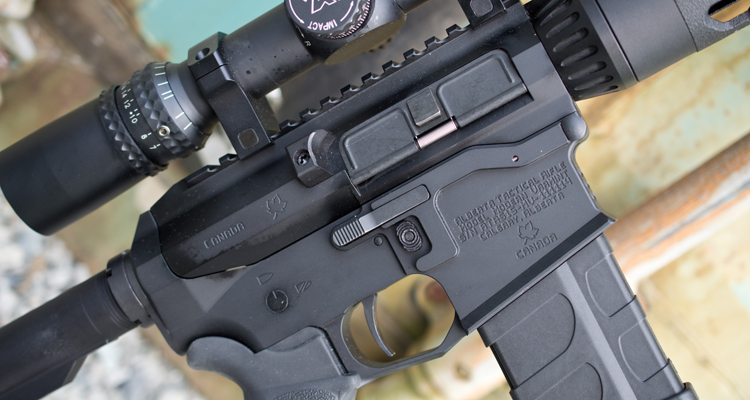
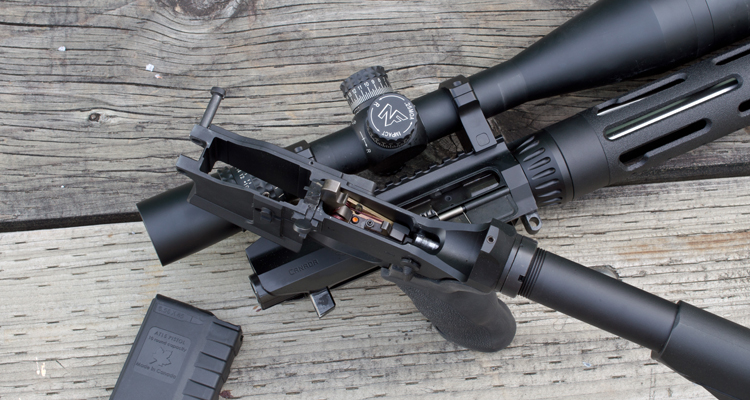
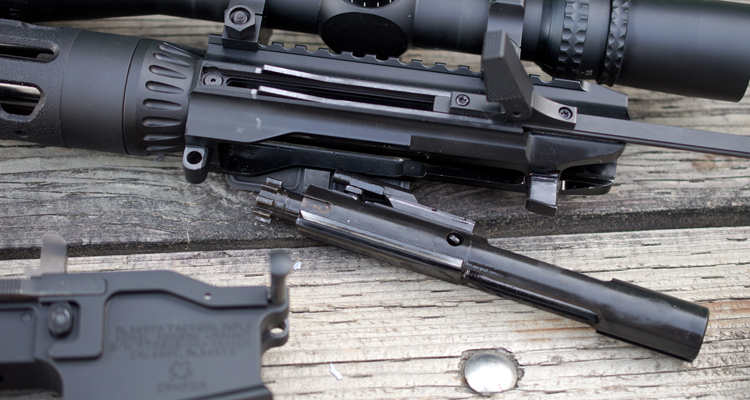
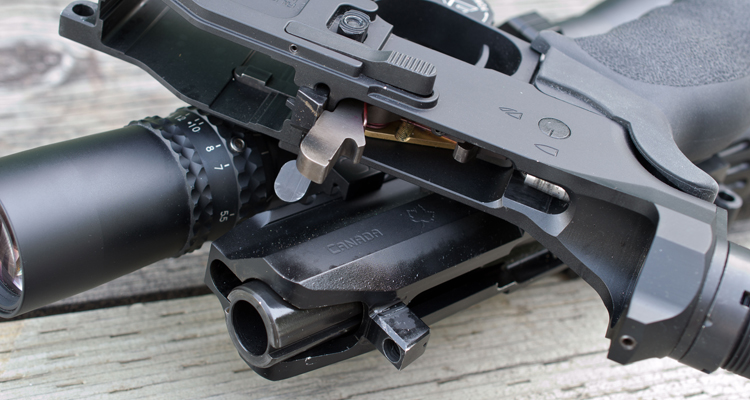 Which makes the Modern Varmint even cooler. This is, literally, the closest thing you can get to a non-restricted AR-15. In fact, from one side, you would be totally forgiven for thinking it simply was an AR-15; an Alberta Tactical Rifle Supply AT-15 to be precise. But there are a few giveaways. First off, there’s the shape of the upper and lower receivers. Unlike an AR-15, which is flat from the front takedown pin to the rear, the Modern Varmint has a step to it to prevent AR-15 receivers from even remotely fitting. Then, there’s the lack of rear takedown pin. Around where the rear takedown pin would be, the upper receiver has a lug with a tapered hole bored through it, parallel to the rifle’s bore. This lug fits snugly over a similarly tapered trunnion fitted into the lower receiver, and the upper receiver is dropped in place, slid rearward over the trunnion, and held there by the front takedown pin. To accomplish this, the hammer must be in the fired position in order to allow the upper receiver to be slid forward, and clear the trunnion. Interestingly as well, when disassembled, the bolt carrier protrudes slightly from the upper receiver; another small difference from the AR-15 that prevents the Modern Varmint’s upper or lower receivers from ever working with an AR-15’s.
Speaking of triggers, that’s the next notable difference: The Modern Varmint does not have the two pin holes in the lower receiver required to accept a conventional AR-15 trigger. Instead, it relies on a Timney drop-in trigger than uses its chassis to locate the transverse trigger pins. This is yet another design touch that further extricates the Modern Varmint from the DNA of the restricted AR-15.
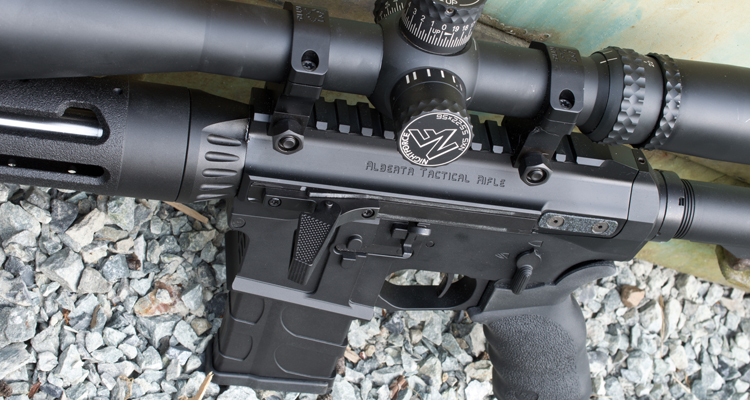 And finally, there’s the charging handle. Some would say, the side charging handle is the largest differentiating factor between the AR-15 and the Modern Varmint, and they wouldn’t be wrong. But they wouldn’t be right either, as numerous aftermarket manufacturers now make side-charging upper receivers for the AR-15. But, nonetheless, it does represent a departure from conventional AR-15 architecture, and so it should be noted. It’s a folding, non-reciprocating affair that engages an excised slot on the front of the bolt carrier, and ATRS has even been thoughtful enough to include a slick nylon insert screwed to the side of the receiver to prevent the end of the charging handle guide rod from marring the rifle’s finish. Likewise, the brass deflector is also replaceable, meaning the Modern Varmint could very well look as good after 5,000 rounds as it does at 50.
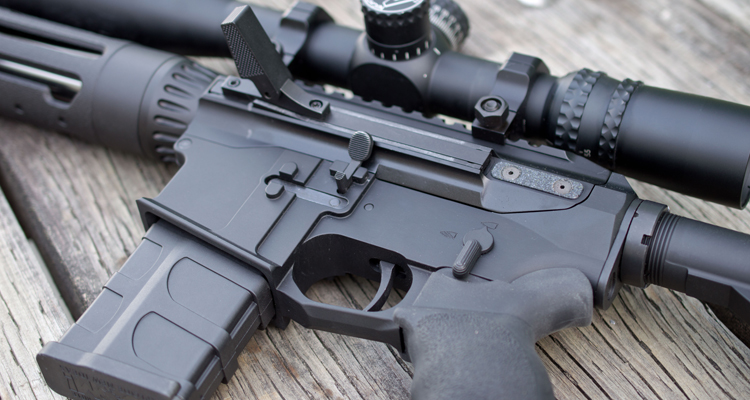 So, now that we’ve extolled all the various ways in which the Modern Varmint is not an AR-15, how can we justify our claim that it’s the closest thing to a non-restricted AR-15 you can buy today? Because while design changes like receiver shapes, takedown pins, and trigger holes may be what ensured the RCMP determined this rifle to be a unique design unto itself, they conveniently have little effect on the manner in which the Modern Varmint handles. Yes, reaching up to charge the rifle from the side isn’t normally how you’d charge an AR-15, but it’s how just about every other rifle in the world works so even that feels pretty natural. The AR-15 furniture, controls, magazines, and barrels all make sure the rifle balances and carries like an AR-15, and direct-impingement gas system and buffer assembly make sure the recoil impulse even feels like an AR-15’s.
Now, our rifle was Alberta Tactical Rifle Supply’s test mule, so we were assured it had seen an ample round count. Actually, we were told it had seen so many mag dumps that it probably had no throat left in the barrel, so it was safe to say the action was well broken in before it arrived. But nonetheless, just to foul up the barrel and a wee bit and get everything moving, we bombed up the included ATRS LAR-15 ten round mag (which are, quite handily, almost the regular AR-15 magazine length) with Israeli IMI M855 62-grain FMJ surplus and poked holes in some paper at 100 yards. We made a couple adjustment to correct the zero in the Nightforce NXS 5.5-25x56 optic, confirmed the results, and sent about 20 rounds down the barrel just for fun. Then, we set the rifle into our lead sled, and set up our test targets. With a pretty decent variety of ammo at our disposal, we shot two five shot groups with each variety, rested off the lead sled with no encumbrances holding the rifle down or otherwise bracing it unnaturally. Between groups we allowed the barrel to cool for approximately five minutes, and we tried to keep each shot roughly five seconds from the next to simulate deliberate fire at about as fast a pace as would be encountered in a practical use of the rifle. We then measured the groups, averaged the two groups shot with each variety of ammunition, and have provided a full table of the results below.
 Now, sharp-eyed readers will note there is a smattering of both 5.56 NATO and .223 Remington ammunition in there. That’s because the Modern Varmint will come with Lilja 1:8 twist, 18.6” barrels as standard, with Proof Research carbon-fibre wrapped barrels as an option… and both will have .223 Wylde chambers cut into them. If you’re unfamiliar with .223 Wylde, it splits the difference between a 5.56 NATO chamber and a .223 Remington chamber by using the external dimensions and lead angle of a 5.56 NATO chamber and the 0.2240 freebore diameter of a SAAMI .223 Rem chamber. This, theoretically, provides the additional accuracy of the SAAMI chamber without risking an overpressure situation when shooting NATO-spec ammunition. In reality, any gains in accuracy take a back seat to simply being able to shoot 5.56 and .223 from the same rifle, as most (us included) are not accurate enough shooters to see a difference downrange between .223-, 5.56-, and Wylde-chambered rifles.
We also used everything from military surplus to hard-core hunting rounds like the Remington Hog Hammer as this rifle, with all its tacticool good looks, would make an undeniably awesome varmint or even deer rifle in some provinces. It’s light (weight varies heavily depending on how the rifle is optioned out though; our test gun was weighed down by the stainless barrel and large optic), has next to no recoil, and can fire everything from barn-burning 5.56 55-grain loads to reasonably heavy hunting hollowpoints and solids. So we wanted to test it with all those. The results were surprising, and show that there’s definitely some serious capability to the rifle; probably even more if you shoot one that hasn’t had the throat blown out by thousands of rounds. It generally seemed to like 5.56 NATO-spec ammunition best, and although it might sound surprising, that IMI’s excellent 69-grain HPBT “Razor Core” ammunition did so well was no great shocker to us; it has consistently proven to be some of the best ammunition we’ve shot out of a whole host of other rifles. However, it’s not cheap, so we were pleasantly surprised that even the IMI M855 shot almost as well. That said, we would take these results with a bit of a grain of salt though, as our rifle’s extremely hard life may have borne out some larger-than-average groups. Were this a rifle fresh out of the box, we’d reasonably expect to see healthy improvements on the group size, and more consistent results from similar ammunition. And of course, if you were to develop a reload for it… well, if Israeli surplus already sub-MOA out of a well-used bore, chances are good you could end up putting together some very small groups with this gun.
 In terms of reliability, we had one round fail to feed. It was the second round fired, during our zeroing and fouling process, and it was attributed to the nose of one M855 round not rising out of the magazine, and refusing to chamber as a result. It never happened again, even with that magazine and that ammunition, so we chalked it up to used error during the loading process. Every other round went off without a hitch. And the trigger was exceptional; a 4-lb Timney unit, it had a nice, crisp break and no grit or creep. Shooting offhand, the heavier JP handguard, big muzzle brake, and mammoth scope made it quite heavy, but that’s really a trait more specific to this particular sample than the breed in general. There’s nothing stopping anyone from fitting a lightweight handguard and a Shield CQS or Aimpoint if they wanted a light, quick, competition-ready gun.
 So, in terms of handling and performance, it’s hard to fault the Modern Varmint. It gives us the excellent ergonomics and modularity we’ve come to adore the AR-15 for, adds the accuracy we expect from an ATRS rifle, and brings that blessed non-restricted status to the table. The combination is a fantastic rifle that is perfectly capable of doing triple duty as a competition rifle, long-range precision rig, and hunting gun. Which is good, because you’ll need to sell your hunting gun, long-range rifle, and competition gun to get one: The starting price is $3,350 and it only goes up from there. Muzzle devices, Proof Research barrels, stocks, handguards, rails, pistol grips, ambi safeties and mag releases… it can all add up. If you opt for the most fully-loaded Modern Varmint you can, you’ll need $6,246 to take it home. That is, unequivocally, a lot of money.
But, developing a rifle isn’t cheap, even if you lean on the work of the brilliant Eugene Stoner to get it done. Building rifles by the hundreds, rather than thousands, isn’t cheap either. Especially when you’re paying good Canadian wages and buying high-quality materials. And of course, laying all this expensive groundwork only to wait literally years for the firearms program to give you the green light isn’t exactly a small financial burden either. So don’t think for a second that these rifles are a “rip off,” or indicative of someone taking advantage of our classification system to turn a quick buck. On the contrary, this is a rifle produced by a company that wants Canadians like you and I to have a rifle that’s as good, versatile, and easy to own as an AR-15, but without the legislative and bureaucratic shackles that rifle comes with. And creating that rifle wasn’t cheap. But what that rifle is, is accurate, quick-handling, comfortable and reliable. So to paraphrase the words of the great Ferris Bueller: “If you have the means, we highly recommend it.”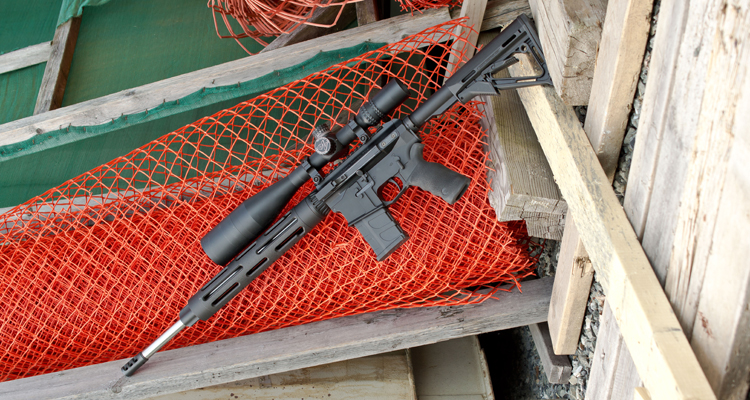
IMI 62 Grain M855: 1.315”
IMI 69 Grain HPBT: 0.932
Aguila 62 Grain 5.56: 3.001”
Remington Premier 77 Grain Match: 1.879”
Remington Premier 69 Grain Match: 2.864”
Barnes RangAR 5.56 52 Grain OTFB: 2.836”
Barnes Precision Match 5.56 69 Grain OTMBT: 2.2”
Remington Hog Hammer 62 Grain TSX Solid: 1.629”
Remington 45 Grain JHP: 1.462”
Remington Premier 62 Grain Match: 2.952”
Aguila 223 Rem 55 Grain FMJ: 2.257”
Remington 223 55 Grain Premium Accutip: 1.531”

 SUBSCRIBE TO CALIBRE MAGAZINE
$30.00 / year
SUBSCRIBE TO CALIBRE MAGAZINE
$30.00 / year
 UNAPOLOGETICALLY CANADIAN MEN'S T-SHIRT
$29.00
UNAPOLOGETICALLY CANADIAN MEN'S T-SHIRT
$29.00
 UNAPOLOGETICALLY CANADIAN WOMEN'S T-SHIRT
$29.00
UNAPOLOGETICALLY CANADIAN WOMEN'S T-SHIRT
$29.00