At Calibre Magazine, we’ve given a fair bit of coverage to firearms from Turkey over the last couple of years, as the combination of a declining Canadian dollar and the growth of the Turkish gun industry has driven importers to look for some new options to keep buyers satisfied. The lion’s share of the Turkish import field has gone to shotguns, running the gamut from entry-level tactical shotguns to the working man’s luxury gun, the ATA Venza. Many of these guns have been downright impressive, which is perhaps unsurprising given Turkey’s history of supplying parts for American shotguns. Turkish handguns, however, are less familiar to most of us here in the west. In fact, we’ll admit that the news we would be receiving a pair of 9mm Canik pistols was met with a significant degree of indifference by the writing staff. But we’re professionals, and we’ll try anything once. So when the Canik TP9SF and TP9SA arrived, we shrugged and opened the cases, expecting to be unimpressed.
But that’s not what happened.
 The Caniks are packed into their cases inside SERPA-type holsters with both belt slide and paddle attachments, two magazines and the usual mag loader, bore brush, and documentation. We’ll say right off that we’re not fans of SERPA retention systems but we do think that some of the hand-wringing over their potential safety issues can be a little overblown. And given that finding molded holsters for what is at this point a brand new gun on this continent will be next to impossible, we’ll call the holster inclusion a plus. Although we’d rather have a third magazine, if there were any space to include it.
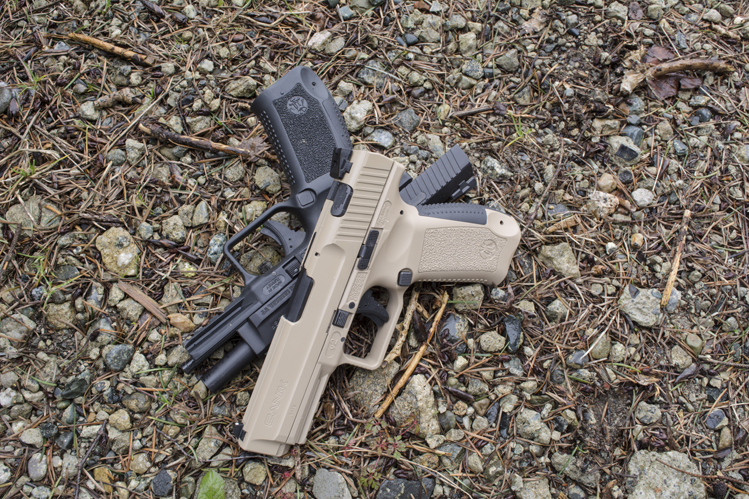
The guns themselves did not look much like we imagined. They’d been on display several weeks earlier at SHOT, the massive shooting trade show in Las Vegas, but we didn’t give them any attention at the time. Despite our positive experience with Turkish shotguns, for some reason we just assumed they’d be crude, cheap, unimpressive guns. They aren’t. The Canik TP9 series are well-executed pistols with sharp, clean surfaces, smooth finishing, and smart design features. There is one critical caveat that goes along with the Canik TP9SA model, though, and we’ll get to that in a minute. But first let’s take a look at these guns.
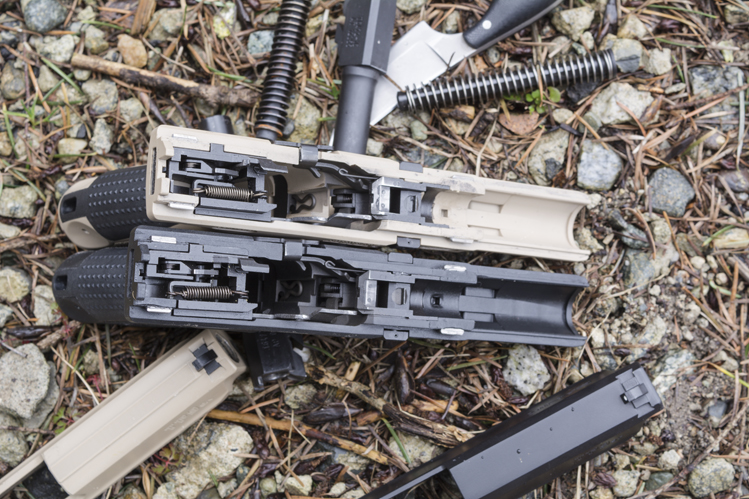 The TP9 platform is essentially copied from the Walther P99, a terrific pistol in its own right. The original TP9 was, like the P99, a traditional double action, with a long, heavy trigger on the first press as the trigger cocked the striker from a relaxed state, and then a much shorter and lighter press afterwards as the cycling action did most of the work cocking the striker.
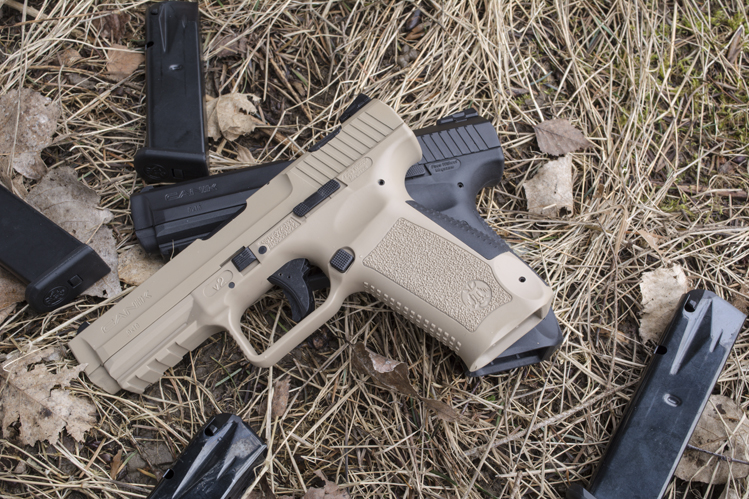
The pistols we tested are the Canik TP9SA, for single action, and Canik TP9SF, for striker fired. The TP9SA is a handsome tan with black accents, and the Canik TP9SF is a deep matte black. Interchangeable backstraps allow some fitting of the pistol to the user’s hand size, although this is accomplished somewhat inconveniently by driving a retaining pin out of the grip. Rather cleverly, this pin doubles as a lanyard attachment point, although we suspect that extended firing with a lanyard in place might require gloves. But the generous trigger guard allowed the use of gloves even on the primate mitts of Calibre’s editor, so at least that isn’t necessarily a hindrance.
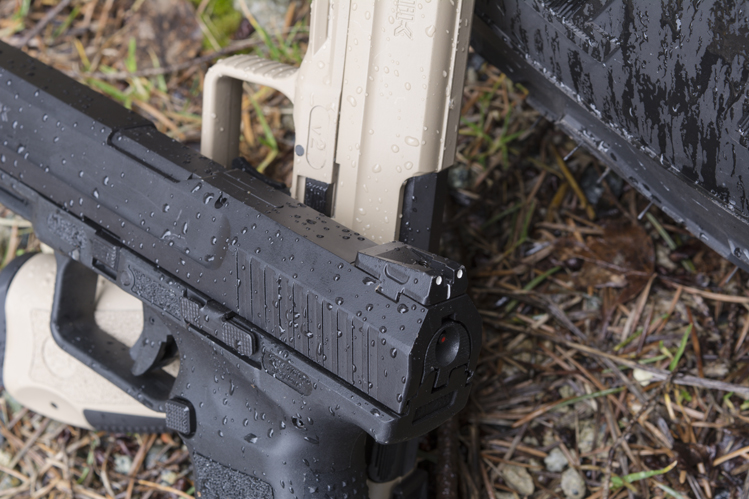
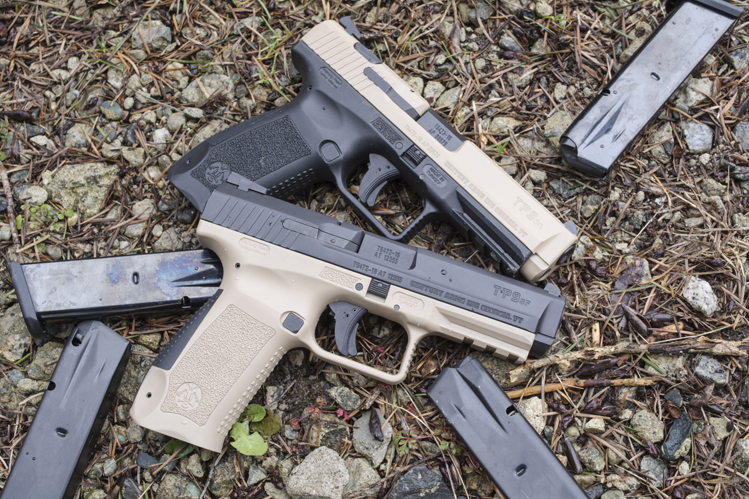 Grip panels are sharply cut and effective, placing the Caniks somewhere between a third and fourth generation Glock for grippiness. The light rail is well-formed and the undercut trigger guard allows for a nice high grip on the frame. The magazine release is checkered and easy to hit without protruding excessively. The slide release is low profile but easy to use, and the slide lock for takedown is large and easy to operate. On the slide there’s a loaded chamber indicator on the top, and the rear slide cover offers a view of the striker, which has been equipped with a red painted dot to warn the user that the striker is cocked Sights are quite well executed for factory sights, the rear having a vertical centre line which makes for rapid and easy alignment. The slide is very nicely contoured, design cues from the P99 being rather obvious. The SF is slightly blockier in profile than the SA, and lacks the attractive serrations on the top of the slide, as well as the unique slide-mounted decocker of the SA.
And now the massive caveat regarding the Canik TP9SA: the decocker design which was carried over from the original double action TP9 does not belong anywhere off the range on the TP9SA. On the TP9, the decocker, which is a large U-shaped button just ahead of the rear sight, simply decocks the action. But the double action trigger will cock it again with a simple trigger press.
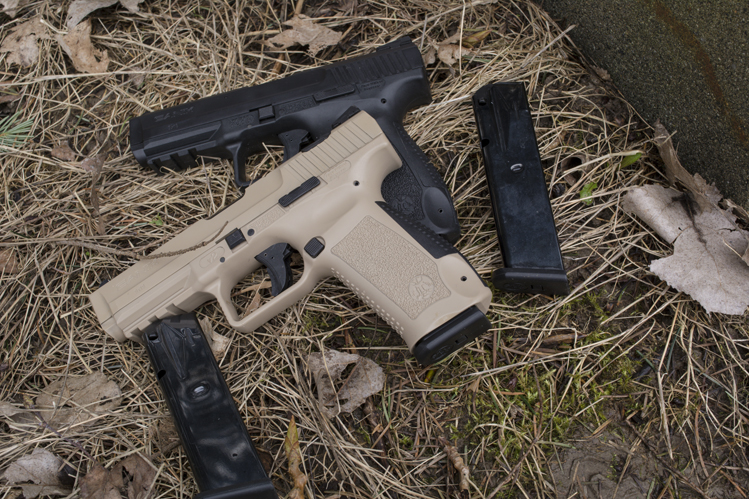 On the single action Canik TP9SA version, the trigger can’t cock the striker. Pressing the decocker renders the trigger dead.
If this gun is never to be used for any defensive purpose, we don’t see this as a major hindrance. Conceivably, there’s even a benefit for a range tool; grabbing the pistol by the slide and pressing down with a thumb disconnects the trigger, and the only way to re-arm the striker is to rack the slide, so guns can be rendered inert very easily.
But on a gun that could potentially be used defensively (and we’ll readily admit that few privately owned pistols in Canada will be), the user runs the risk of having the gun switched off by anyone who grabs the slide. The importance of understanding this defensive issue cannot be overstated.
The Canik TP9SF has no decocker. For a pistol that has any potential for defensive use, we would select the TP9SF.
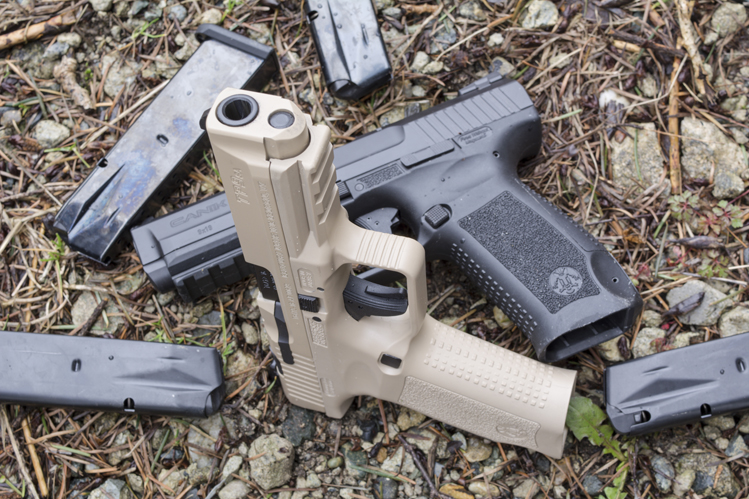 Ironically, the decocking feature allows the disassembly of the SA without pressing the trigger, addressing one of the single largest complaints about most striker fired designs, so if it were not a major issue for anyone potentially facing a gun grab attack, this would actually make a pretty good issue pistol for law enforcement or military use. Administratively, it’s a great feature. It just has no place on a fighting pistol.
What does belong on a fighting pistol is this trigger. It’s very clean, with a strong, positive reset, although like a lot of Walther creations, the pivot point location makes the trigger a little “swoopy”, and we managed to find one person with a sufficiently skinny index finger (don’t stick your hands in lawnmowers, kids) that was able to get such a high grip on the pistol that they missed the now-ubiquitous trigger safety and couldn’t activate the trigger. It’s therefore theoretically possible that if you have weird skeleton hands and a high enough grip, this trigger won’t work for you. Normal-handed people should be fine.
Speaking of normal hands, the TP9 series are not truly ambidextrous. The magazine release can be configured for either side but the slide release is left side only. We don’t see this as a significant hindrance but it’s worth knowing.
 Given the relative rarity of these pistols, aftermarket support will be weak, which may turn out to be the only significant downside. Ours shot accurately, with 115 grain UMC performing particularly well and point of aim aligning with the top of the front sight at 25 yards. Recoil is energetic for a 9mm but it’s still a nine, and it didn’t negatively impact performance.
These pistols are retailing for under six hundred dollars and while so far, nobody can guarantee their long-term durability, we’re going to be extremely surprised if they don’t hold up pretty well. The code seems to have been cracked on building reliable polymer service pistols, and it’s just not the domain of any one manufacturer anymore. These machines are impressive, and not just in terms of bang for buck; these are flat out good pistols. If you’re prepared to go a different route from the mainstream and aftermarket support is not a major factor for you, give one a try. We think you’ll be impressed.

 SUBSCRIBE TO CALIBRE MAGAZINE
$30.00 / year
SUBSCRIBE TO CALIBRE MAGAZINE
$30.00 / year
 UNAPOLOGETICALLY CANADIAN MEN'S T-SHIRT
$29.00
UNAPOLOGETICALLY CANADIAN MEN'S T-SHIRT
$29.00
 UNAPOLOGETICALLY CANADIAN WOMEN'S T-SHIRT
$29.00
UNAPOLOGETICALLY CANADIAN WOMEN'S T-SHIRT
$29.00