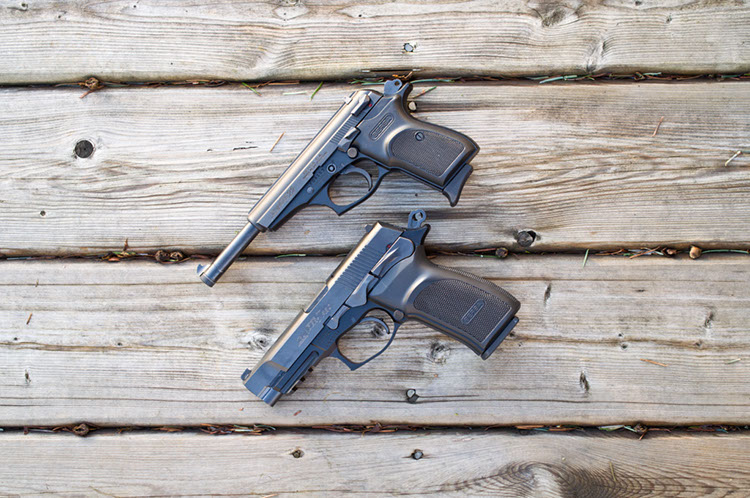
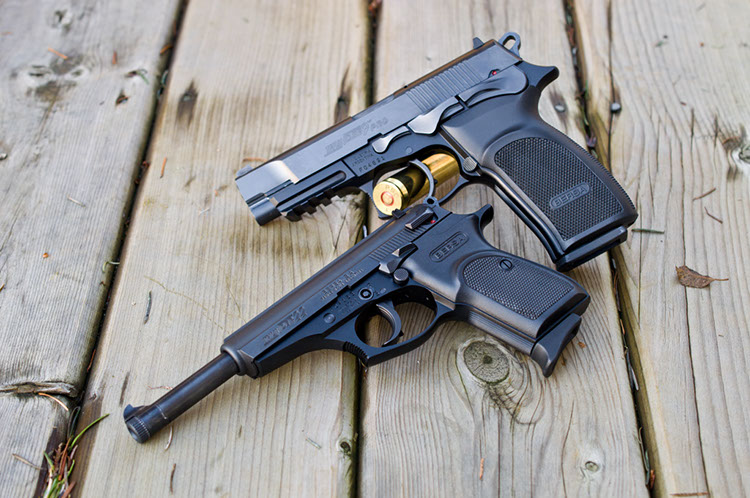
 The Argentine firm Bersa has been building guns since the 1950s and supplying the Argentina Armed Forces and Federal Police with handguns for about fifteen years, but Canadians haven't had access to them...until now. So, these could be guns and models you're not too familiar with but could definitely become more popular in the years to come, perhaps something similar to these XR9s that you can see in this Boberg XR9s Overview, as an example. Tactical Imports has brought in the Bersa Thunder 9 Pro and Thunder 22-6, and we've got one of each to use and abuse. Worth adding to your collection? Let's find out.
Bersa
Bersa is new to Canada but known to many US buyers as a maker of compact guns for concealed carry. They're clearly influenced by classic Walther designs, ranging from small-calibre blowback pistols modelled after the PPK to the full-size Thunder 9 Pro, which takes its cues largely from the Walther P88. And they've certainly had a lot of success in their own domestic market, securing lucrative contracts with the army and federal police, not to mention large municipal police forces in Argentina. Their lower labour costs allow them to manufacture designs which require enough machining to be impractical to manufacture in the first world, while keeping costs low enough to make the guns very attractively priced. But can bargain-priced guns compete? Let's have a look at how the features stack up.
Thunder 9 Pro Features
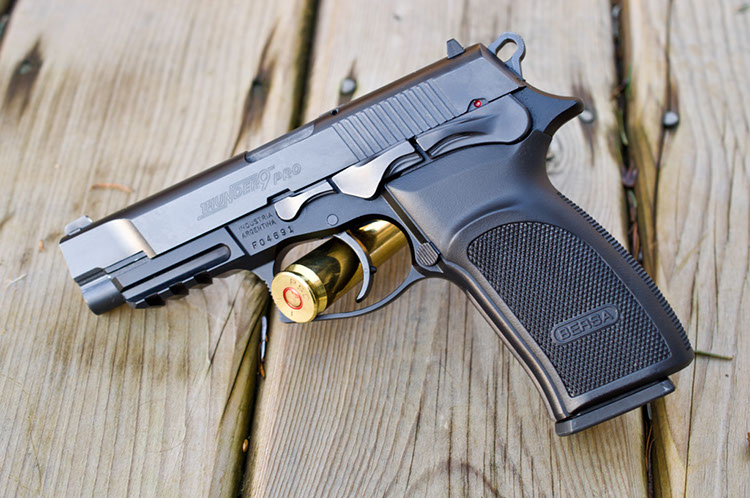 The Thunder 9 Pro is the pistol of the Argentina Armed Forces, Argentina Federal Police and the Buenos Aires Police. It's a traditional double action pistol, that is: the first trigger press is long and heavy and cocks the hammer; subsequent trigger presses are light and short as the hammer is cocked by the slide as it cycles. As with most TDA pistols, the hammer can be decocked with a lever (in this case located at the rear of the pistol); this lever also acts as a safety, disengaging the trigger when left in the "safe" position. Like all controls on the Thunder 9 Pro, the decocker/safety is fully ambidextrous and easily accessed.
The trigger press is a little quirky. The double-action press, at 17mm, is very long, 2mm longer than the first press on a Sig P226, and the trigger pivot pin is a couple of millimetres further forward. This makes the first press long and a bit swoopy: there's a lot more vertical travel in the trigger than most auto pistols that I have used and contributes to a bit of a stacking sensation at the end of the press. On the other hand, the reset is short, at a little under 4mm, not much different than a factory Glock. I set 1911s to 2.5mm, and the SRT 226 is about 3mm. The older 226s are closer to six. Additionally, the reset is positive and tactile - there's plenty of return pressure and you know when you've gone far enough to reset the trigger. In my opinion, those are the keys to running a trigger quickly.
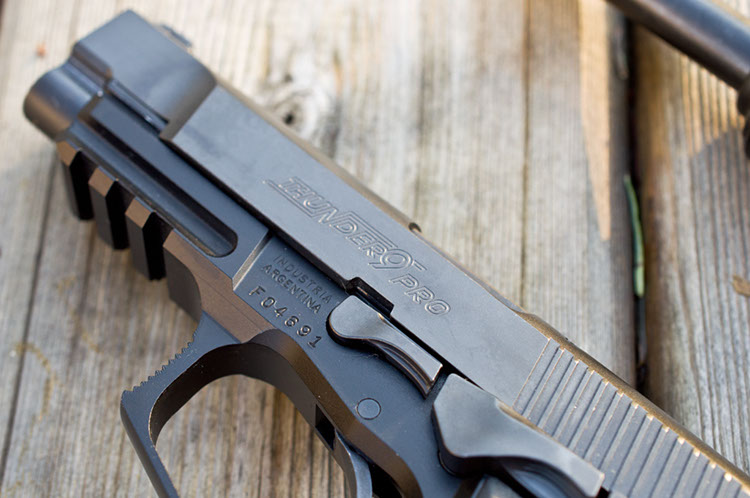 Ahead of the decocker is the slide stop. The placement is similar to a Glock or 1911 and well forward of the slide stop on, say, a Sig 226 but again, fully ambidextrous with an identical lever on the right hand side of the pistol. This is, in my opinion, the right spot for it. Many shooters find that they need to adjust their grip to avoid the 226's slide stop, which can otherwise prevent the slide from locking back on an empty magazine; this will not be an issue on the Bersa.
The magazine release is serrated and easy to operate, yet well-protected by the contours moulded into the factory grips, which are decently textured and paired up with a serrated front strap, making the gun secure in the hand. The grip is very similar in size and layout to a pre-E2 Sig 226, but slightly more angular.
The Thunder 9 comes with 3-dot sights with white dots and if you don't have a specific need to upgrade to night sights, the factory ones work very well. In fact, they are some of the better factory white dots I've seen for one simple reason: the front dot is bigger, and thus brighter, than the rears. I wish more manufacturers did this. I want my eye drawn to the front sight as fast as possible; Bersa apparently gets this, so kudos on that. If you do want to replace the sights, they're a standard 226 sight, which again is excellent because it gives you plenty of options. Too many manufacturers bring a gun to market with one-off oddball sights and it takes the aftermarket years to make a selection of sights, and when they do, low production numbers make the sights expensive. Bersa apparently gets this too.
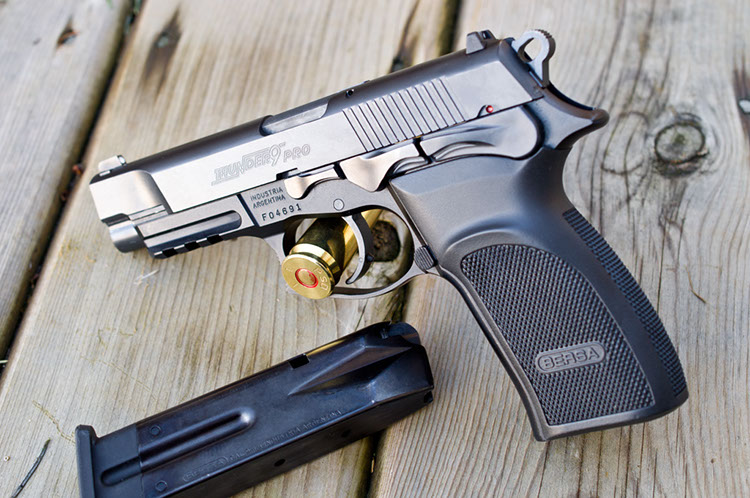 Just barely visible between the sights is a loaded chamber indicator. I'm a little indifferent to the existence of such devices; if I need to know badly enough that I don't trust my gun's normal tendency to load the top round out of the magazine, I probably won't trust the LCI either. But it also doesn't hurt anything and enough people do like them that I'm not inclined to complain about their presence. This one is effective while remaining unobtrusive.
Under the barrel is a standard Picatinny rail which will mount any of the usual lights or lasers from Surefire, Streamlight et al. For the purposes of this test, I left it empty, although I did check to make sure an X300 would fit on. No problems there. It's not hard to make a rail that works.
Magazines are proprietary and the Bersa only comes with one, so order extra when you buy. They're reasonably priced limited-capacity versions, with extended plastic baseplates that fill the magazine body rather than standard capacity held to 10 with pop-rivets. It's always tempting to look for pinned, standard-capacity magazines but with a sole supplier and a new import, I think we'll be stuck with factory 10s for a while. There are no aftermarket sources for magazines at this time, which is probably a good thing: many shooters underestimate the role of magazines in determining the reliability of a gun, and sadly, many aftermarket magazine suppliers do the same.
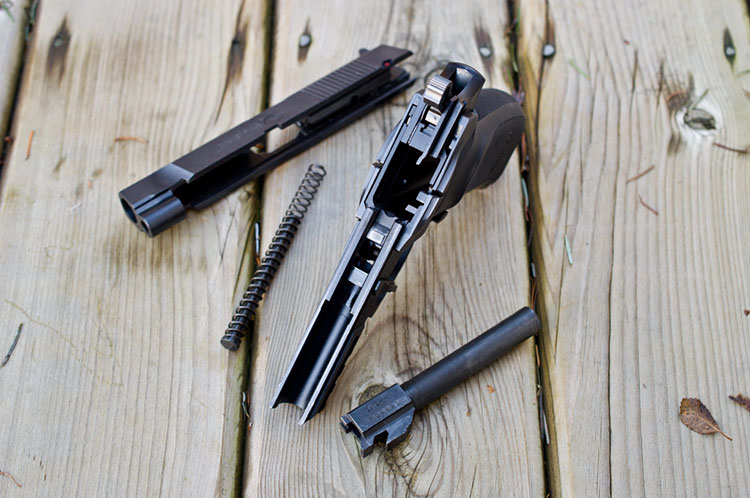 Field stripping the Thunder 9 is unbelievably easy. There is a takedown lever on the left hand side of the gun, in much the same location as on a 226. Unlike the 226, there's no need to retract the slide to a particular position before throwing the lever, you simply rotate it downward ninety degrees and remove the slide. The guide rod holds the recoil spring in place until you lift it away from the barrel, and then the barrel can be tipped out of the slide. Simple.
Overall, this is a well-laid out pistol. The controls are easy to access and operate. The factory sights are good enough to leave on unless or until you have a specific need for something else. The trigger is a bit odd on the first shot but it's something that could be trained around. The single action press is clean and the reset is short and positive. The machining looks good throughout and the finish is clean and even. If it was delivered without roll marks and I was told it was a Walther, I'd have believed it.
Shooting the Thunder 9 Pro
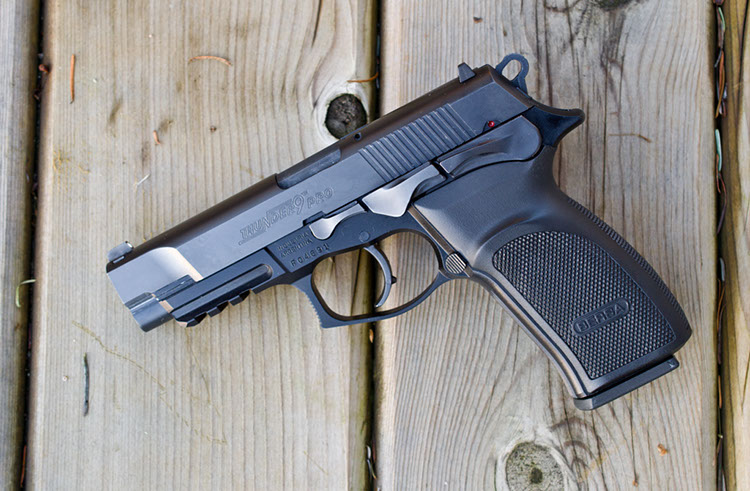 I'll just flat out say it: this gun shoots well. It's a very easy gun to shoot accurately. Granted, the double action trigger press is long and heavy, and there's some stacking in it about three quarters of the way through. It's a duty trigger, not a competition trigger. And the sights are a little crude for distance work - I found it very difficult to keep my shots all in the black at 25 yards on a B8 target. But anywhere up to 15 yards, the Thunder 9 would drill out ten shot groups with all holes touching. It was not difficult to knock out a one inch square at seven yards, even on the long double action press.
I did manage to get the Thunder 9 to cough once: by loading a magazine full, chambering a round, ejecting the mag and replacing the round to get 11 rounds total into the gun, and using aluminum-cased Blazer, I did get single failure to extract in the first twenty rounds the gun fired. I don't find this remotely concerning; aluminum-cased Blazer is typically the ammunition that most sensitive guns will choke on, even if they'll run everything else, and I was only able to get that one malfunction, when the gun was absolutely brand new. I mention it mainly because otherwise there's nothing to say about the reliability. It chugged through 200 rounds of aluminum Blazer afterwards with no bobbles, and a similar amount of PMC bronze.
Thunder 22-6
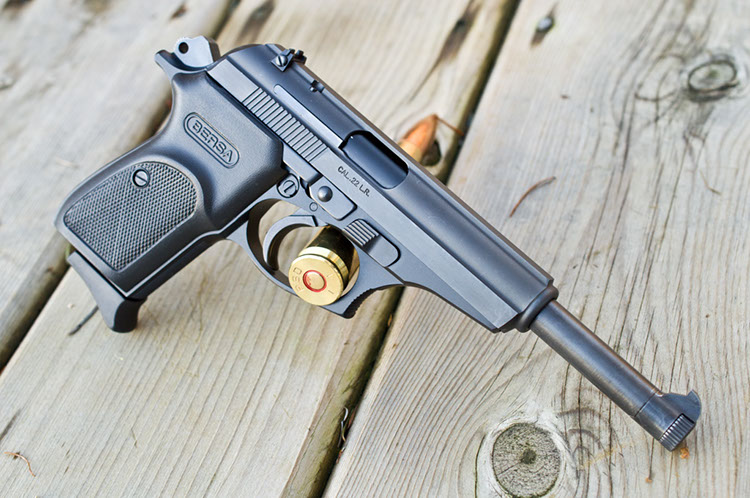 I don't think I'm the only guy with a soft spot for blowback PPK-type guns. In fact, Argentina apparently has a lot of guys like me, because Bersa builds a lot of PPK-type guns, in both .22 and .380. Unfortunately, while a 5" barrelled .44 magnum is safe enough for me to own, and a 12 gauge shotgun is so safe I can leave one in the trunk of my car, most of the Bersa .22s have a 3.5" barrel, and a .22 with a three and a half inch tube is, of course, far too dangerous to even let into the country.
Fortunately, Bersa also builds a 6" barrelled target version, the Thunder 22-6, and that extra sixty millimetres of pipe makes it safe for Canadians to own somehow, and I guess I can at least be thankful for that, because here I am with one to test.
It's a quirky looking beast, half PPK, half Pinnochio. But I can own it in Canada, unlike the rest of their blowback guns. So let's start with that extended barrel.
The Thunder 22s (and .380s, for that matter) all have a fixed barrel which is pressed into the frame and pinned. The odd thing about the extended barrel on the 22-6, though, is that the front sight is mounted directly on the barrel, which means it has to be removed every time you want to field strip the gun. Bersa has applied a pretty clever system to ameliorate this problem: the front sight is mounted to a sleeve which locks into a keyway on the slide, and is held in place by a toothed ring which screws onto the barrel. A tiny detente mounted in the sight interfaces with the teeth on the ring, locking it in place, but allowing casual removal without tools. To be honest, pulling my front sight regularly doesn't make me feel great. On the other hand, if you're going to try for maximum accuracy with this machine - and let's remember: it's a plinker, not an olympic target pistol - you could always leave the front sight in place and pop the slide loose and spray it out. It's a blowback .22, so regular cleanings will be necessary.
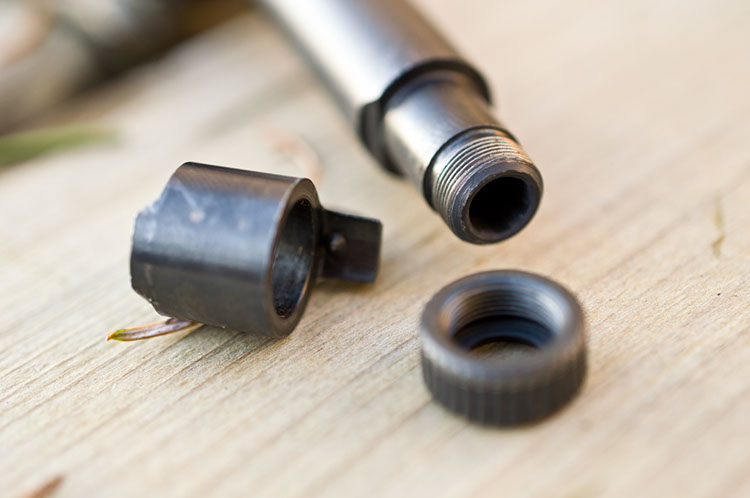 Personally, I'd probably just give up on trying to attain theoretical accuracy, and remove the sight for cleanings. After all, the front and rear sights are mounted on two different components, one of which moves.
Let me just mention the one other quirk on this gun that I don't like, and then I'll move on to the good stuff, of which there is quite a bit: there's an internal trigger lock that can be activated with a key so you can switch the gun to "safe" mode. I just don't get features like this. Gun safety is a function of the operator. If it's in your hands, you don't need a key, you need to be following safe gun handling procedures. If it's not in your hands, are you going to trust the mechanical safety? I know I'm not, so I'd rather forego the option of switching the gun off. To be fair to Bersa, so far I haven't figured out any way you could switch it on accidentally. But I know there's someone out there more enterprising than I am, so sooner or later, someone's going to figure out a way to get it wrong.
Aside from those little quirks, neither of which are really deal-breaker s for me, this is a nice little pistol. Classifying it is almost awkward - the diminutive size, blowback design and low price tag put it almost in the realm of cheap US mouse guns, but the Bersa sports a level of machining and materials of which the pot-metal Jennings/Lorcin/Raven builders can only dream. It's almost more like a modernized German prohib pistol, for those of us who can't buy the old classics.
The trigger is more of Bersa's traditional double action methodology, with a long heavy press on the first shot and a short, light press thereafter. Like its larger cousin, the Thunder 22 has a decocker which resets the trigger back to that long double action press, and also functions as a trigger disconnect safety. It's mounted in the traditional PPK location on the slide and has a nearly ninety degree throw. That's not a problem, but be aware you need to rotate it the whole way if you want it to engage correctly.
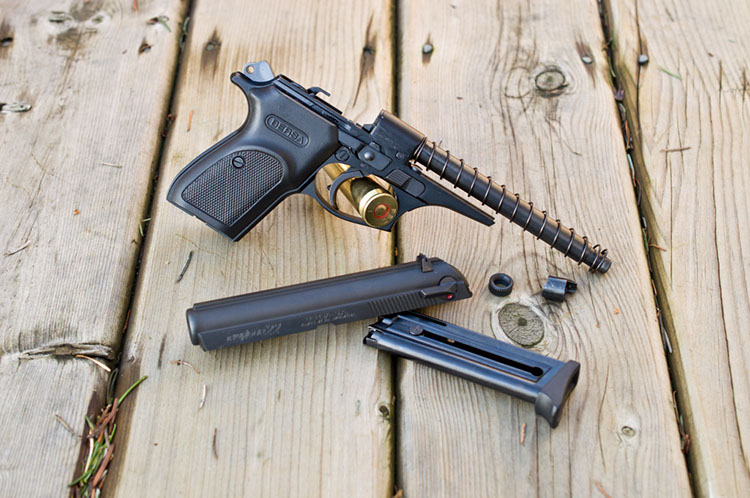 Forward of the decocker/safety is a very nicely machined slide stop with a ridged pad for releasing the slide; a checkered mag release which, in typical Bersa fashion is both easy to reach and operate but well protected against accidental triggering; and a well-executed trigger with a more neutral pivot position than the Thunder 9.
The trigger press itself is not bad at all. The double action press is a little crunchy as it overcomes the magazine disconnect - okay, that's another feature for which I have no use, but it's easy to remove at least - but the glitches are so early in the trigger travel that they don't really affect the accuracy. The reset on the 22-6 is longer than on the 9, but perfectly reasonable and light with a clean break and reset.
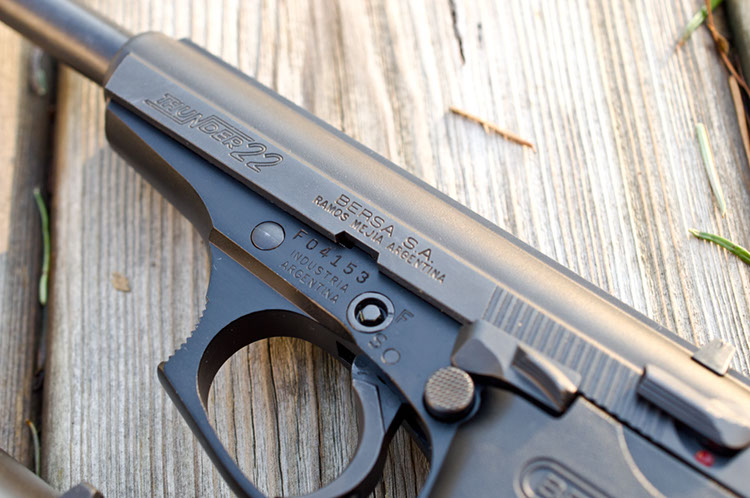 The finish is a beautiful matte black, the surfaces are uniform and smooth and the small parts are clean. The serrations are crisp and well-executed without being sharp and the sights are effective and adjust smoothly. The magazines are solid and allow you to depress the follower with a thumb and forefinger which makes loading easy - a nice feature.
Prior to this article, I was aware of Bersa but had never given any of their pistols a serious look. If the two I have here are representative samples, I'm impressed. This is quality manufacturing. I could go on, but for the moment I'm too busy arranging to have the barrel on the 22-6 cut down to 106mm, and a sight pinned to the slide. Not everyone needs their PPK fantasy fulfilled and the 22-6 is worthwhile in its own right...but if you're interested in a modernized PPK in .22lr, this gun is nice enough to be worth sinking a little effort into.
Shooting the Thunder 22-6
The importer warned us that the 22-6 would need high-velocity ammo to run well, and it's definitely true that CCI Mini-Mags would cycle it like crazy. More interestingly from my perspective was that as long as I kept the gun wet - like Beretta wet, oil on your hands wet - I could run Federal bulk ammo no problem. That's pretty good for a blowback rimfire! My instinct is to run axle grease - which is really just oil mixed with a thickening agent - to get it to hang on the gun for longer. I think that would probably allow me to get through a few hundred rounds of decent bulk .22 and that'll be the first thing I do after I get the barrel cut down to 4.25".
I could group the .22 around 2 inches at 10 yards, although I found the sights too crude to get good results at 25. Still, I feel that there is accuracy potential there if you want to work for it. The recoil is pretty sharp for a .22, but then it's a blowback gun. Overall I found it pretty enjoyable to shoot and I'm looking forward to spending more time with it.
Conclusions
Bersa is not playing around. The Thunder 9 Pro is a serious service pistol and I think that it could definitely be a contender in any application you might see for a Sig P226, Glock 17, or Walther PPQ. The factory sights are the only thing holding back significant accuracy potential and they can be replaced in minutes with any sight that fits the P226, which is an absolute boon for the user. For people who will shoot it primarily under 10 yards, the factory sights are perfectly adequate and they're fast to acquire. The only downside of which I am aware is the lack of aftermarket grips if you feel the need to change them. Personally I'd probably stipple the factory grips with a soldering iron, drop night sights on the gun and never look back.
The 22-6 is a quirky machine but if you want a steel .22 that feels like a real gun, not a pot metal imitation, I think it's a good starting point. The factory is apparently uninterested in building these with 4.25" barrels, which I find maddening. I found my example hit a bit high and right, and I worried that the point of aim would shift or wander with enough field strips, since the front sight has to be removed every time. For me it fills a specific void: I just like the PPK and this is a fairly good analog that's cheap to shoot, so I'm probably going to have the barrel cut down and a front sight dovetailed into the slide.
Bottom line: I'd buy a Thunder 9 Pro. I think it's the most underrated service pistol I've ever shot. The 22-6 is a little more of a niche gun, but it's fun and I think it's worth a look. If they ever do build a 22-4.25, I don't think they'll be able to keep them on the shelves.

 SUBSCRIBE TO CALIBRE MAGAZINE
$30.00 / year
SUBSCRIBE TO CALIBRE MAGAZINE
$30.00 / year
 UNAPOLOGETICALLY CANADIAN MEN'S T-SHIRT
$29.00
UNAPOLOGETICALLY CANADIAN MEN'S T-SHIRT
$29.00
 UNAPOLOGETICALLY CANADIAN WOMEN'S T-SHIRT
$29.00
UNAPOLOGETICALLY CANADIAN WOMEN'S T-SHIRT
$29.00