
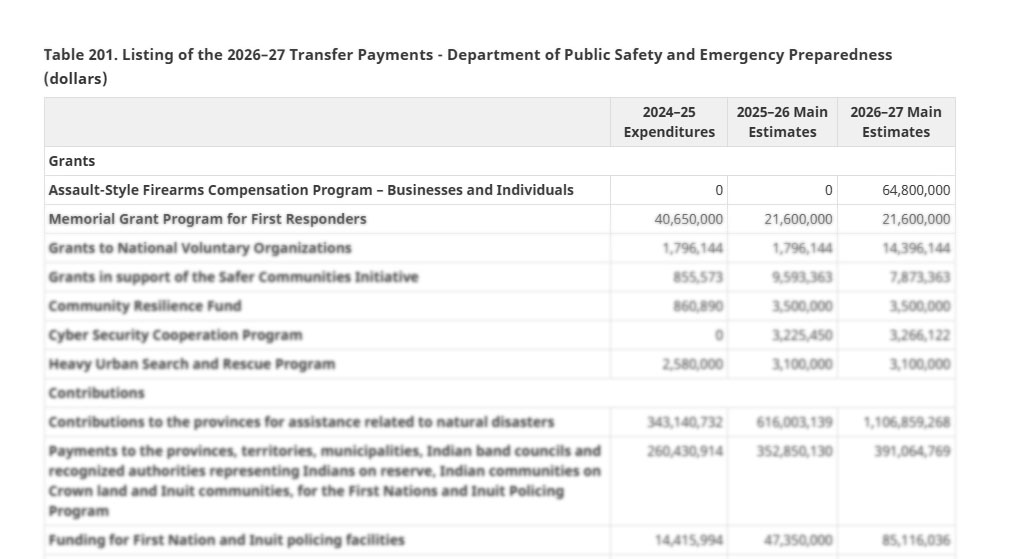
As reported previously, although the pending 2026-2027 fiscal year will see the Assault-style Firearms Compensation Program (ASFCP) eclipse the $1BN spending mark, it comes with an expected surprise: That the amount of compensation that will be available to participants of the program has plummeted from the $250M promised earlier this year to just $64.8M - creating concerns that owners may receive significantly less than initially expected - if anything at all.
When launched just over two months ago, the Minister of Public Safety, Gary Anandasangaree, indicated that the amount of total compensation available to individuals would be capped at $250M. To back this commitment, Public Safety Canada requested $260M in spending authority from the Treasury Board for the 2025-2026 fiscal year, to support transfers of funds to individuals and businesses as part of the ASFCP - ostensibly including the $250M for individuals referenced by Minister Anandasangaree, with an additional $10M to cover off claims made by businesses during the first phase of the program, late last year.
But because Public Safety Canada has stated that the processing of compensation claims will not begin until after the declaration period ends on March 31st, which happens to (coincidentally) be the last day of the 2025-2026 fiscal year, none of the claims for compensation will fall within the same fiscal year for which Public Safety Canada sought the promised $250M in total compensation. Instead, they will be processed within the 2026-2027 fiscal year, for which Public Safety Canada has sought $64.8M in spending authority to compensate owners participating in the ASFCP; a $185.2M reduction from the initially promised amount.
For gun owners who have opted to participate, this has led to the obvious concern that the significant reduction in available compensation will have ramifications on the amount eventually provided. According to the government, the $250M in available compensation they committed to in January was intended to provide compensation for an estimated 136,000 firearms, with the resulting estimated average compensation per firearm of $1,838 echoing explicit government claims of paying, on average, $1,800 per firearm.
But with only $64.8M available, the government intends to either compensate owners for just over 35,000 firearms in total or significantly reduce its benchmark payment per firearm. The former would reflect the government’s original position that claims would be paid out “fairly,” and that all declarations received after the available funding had been exhausted would simply not be eligible for compensation.
In the latter case, if all claims are to be paid, based on the 51,000 firearms declared, with one week remaining before the program’s conclusion, the average compensation per firearm falls to $1,270. If uptake remains modest, and the program’s total claimed firearms remains at or below 60,000, the most participants can expect to receive on average is just over $1,000.
Put another way, in the case of the former outcome, somewhere upwards of likely 20,000 gun owners who have opted to participate in the ASFCP, and who have volunteered all the information participation requires, will receive no compensation for voluntarily offering their firearms up for confiscation. In the latter, all participants will, on average, receive almost half of what they expected to.

 SUBSCRIBE TO CALIBRE MAGAZINE
$30.00 / year
SUBSCRIBE TO CALIBRE MAGAZINE
$30.00 / year
 UNAPOLOGETICALLY CANADIAN MEN'S T-SHIRT
$29.00
UNAPOLOGETICALLY CANADIAN MEN'S T-SHIRT
$29.00
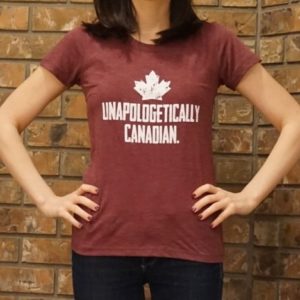 UNAPOLOGETICALLY CANADIAN WOMEN'S T-SHIRT
$29.00
UNAPOLOGETICALLY CANADIAN WOMEN'S T-SHIRT
$29.00