
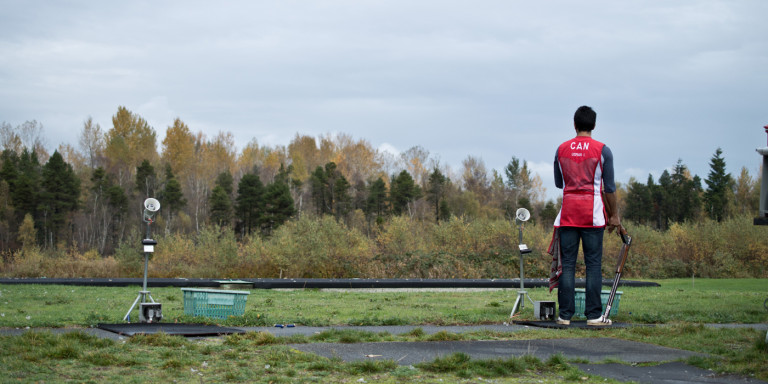
Few of the shooting sports are as easily approached as those involving the venerable shotgun. While things like IPSC, 3-Gun, or even long-range marksman competition require multiple firearms, expensive gear, or additional certifications to participate, the ever-present and ever-popular shooting sports of trap, skeet, and sporting clays and their various derivatives require little more than a cheap single-shot or pump-action shotgun and a willingness to learn. Here's a crash course on the clay games.
By far the most popular of the clay shooting sports, trap has been around for literally hundreds of years, with some evidence of its inception dating all the way back to 1750. Initially, the game used live birds released from underneath hats, before transitioning to glass balls thrown in the air by hand around 1860. By just 1880 those too were replaced by early forms of the clay discs currently used, and by 1909 the automatic target thrower had been invented, giving rise to the game as it is shot today.
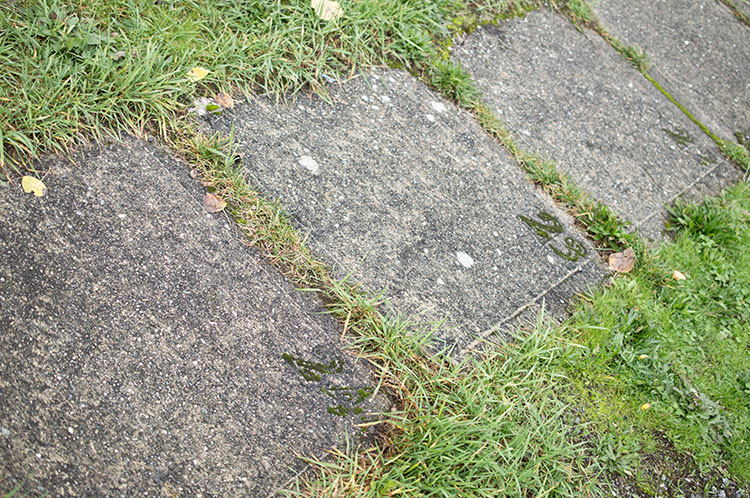
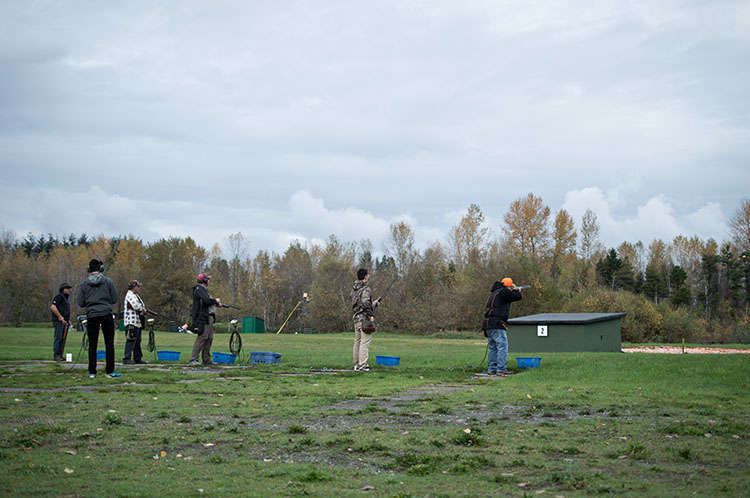 Trap, as it is now shot, involves five shooting stations in a line abreast positioned 16 yards from the trap house; the small housing within which the automated throwing machine resides. The centremost station is obviously centred behind the trap house, and each successive station is a few metres left or right from the next one over. Typically, the stations are paved pathways set into a grass field, and stretch rearward from the 16 yard line to the 27 yard line. In competition, shooters engaged in "handicap" matches shoot from various yardages ranging from 18 to 27 yards, in order to increase the difficulty of the game.
The throwing machine oscillates left to right through anywhere from 34 to 54 degrees, or 17 to 27 degrees off-centre. The targets typically travel anywhere from 48 to 52 yards total, but must rise to be between 8 and 12 feet above the ground at the ten yard mark. This typically means the target is moving at roughly 65 kilometers per hour. The variations in distance can be accredited to winds or even atmospheric pressure changes. This brings us to the key component identifying trap, in all its various forms: The target are generally shot on the rise and always travel away from the shooters.
 In order to shoot trap, the squad (as the group of participants is known) takes their positions, and the first shooter places one round in their shotgun. They adopt their ready position, whatever it may be, and call for their target. Through either an automated microphone system or a dedicated scorekeeper/puller, the throwing machine is triggered, and dispenses a target. The shooter takes their shot, opens their shotgun's action to eject the spent shell and leaves it open to demonstrate that the gun is unloaded to the other members of the squad, and the next shooter loads and makes ready. When each shooter on the line has called for five targets, they all move one station to the right, with the shooter in the rightmost position moving behind the firing line to take the leftmost position. After 25 targets have been thrown the round is over.
Etiquette: Trap is a formal game, one which respects rhythm, and demands consistency. Loading more than one shell, moving around excessively, calling for targets in a "vulgar" or otherwise distracting manner will earn you black marks.
Tip: For first time trap shooters, concentrate and practice a consistent gun mount, and begin by placing the bead of the shotgun on or slightly above the top edge of the trap house ahead when calling for the target. Continue to sweep the muzzle through the clay as you squeeze the trigger to ensure a clean follow through.
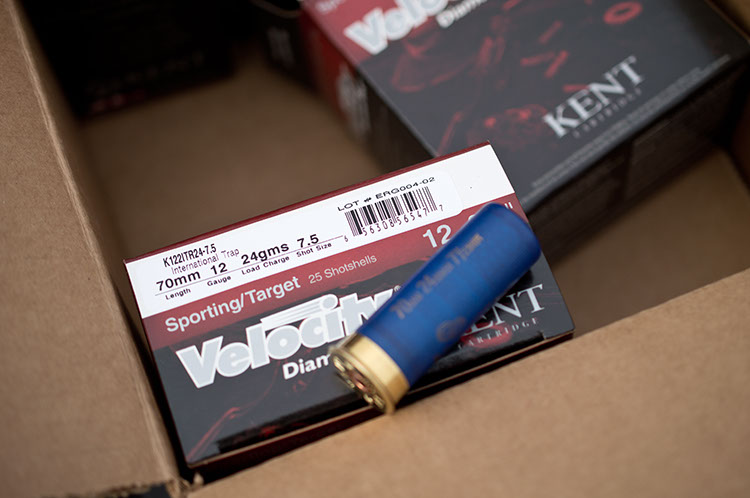 Other versions to try: Olympic, international, or bunker trap. In this game, the targets are thrown any number of different directions and at various angles up and down; the only guarantee is that they're all going much faster than American or conventional trap targets and can exceed 100 kph depending on the direction and angle the target is thrown. Furthermore, loads are prescribed, and cannot exceed 24 grams, or slightly less than 7/8th of an ounce.
Skeet is slightly more complex than trap, with twice as many target throwers, more shooting stations, and more targets. Comparably much newer than trap, it was created in the 1920s by Charles Davis; an avid grouse hunter living in Andover, Massachusetts. Initially called "Clock Shooting," the game first involved a circular array of shooting stations arranged like a clock face around a 50 yard diameter, with a single throwing machine positioned at the 12-o'clock position to throw targets in any direction. However when a chicken farm moved in next door, Davis had to modify his game to restrict the shooting directions, which led to the installation of a second throwing machine at the 6-o'clock position and a halving of the shooting positions.
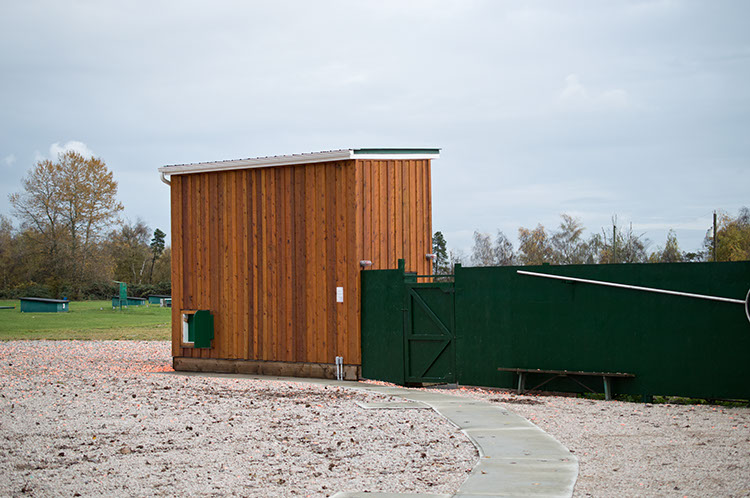
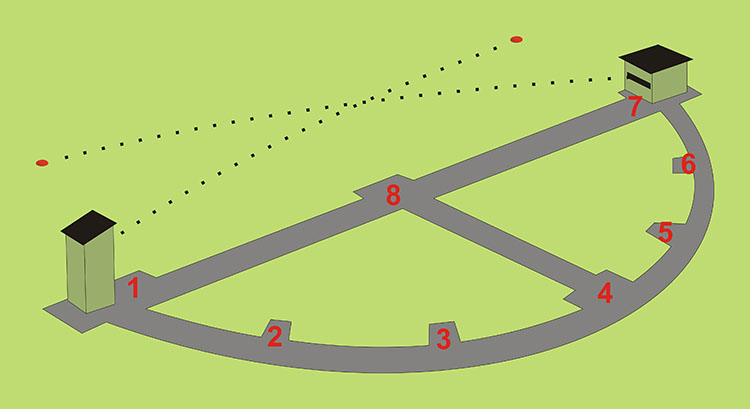 Now, the game involves a semi-circular array of seven shooting stations, with an eighth station positioned in the center of the semi-circle right between the two throwing machines. The machines themselves are housed in the skeet houses located just behind shooting stations one and seven. Although not required to be of any particular heights, the two houses are always two different heights, with the house to the left of the field being the "high house" and the house to the right being the "low house." Targets are thrown from windows in each house, slightly away from the shooting positions, so that they cross at a virtual point 18 feet in front of the eight position and 15 feet above the ground. The targets must also fly 60 yards from their point of origin, but are considered "out of bounds" at the 44 yard mark.
Like trap, the game consists of squads of no more than five shooters, with 25 targets per participant. Also like trap, only one participant shoots at a time, so all guns remain open and unloaded until an individual is ready to call for a target. However, unlike trap, the squad moves through each shooting station together. In other words, all participants take their turns shooting from station one, before the entire squad progresses to station two, and so on and so on.
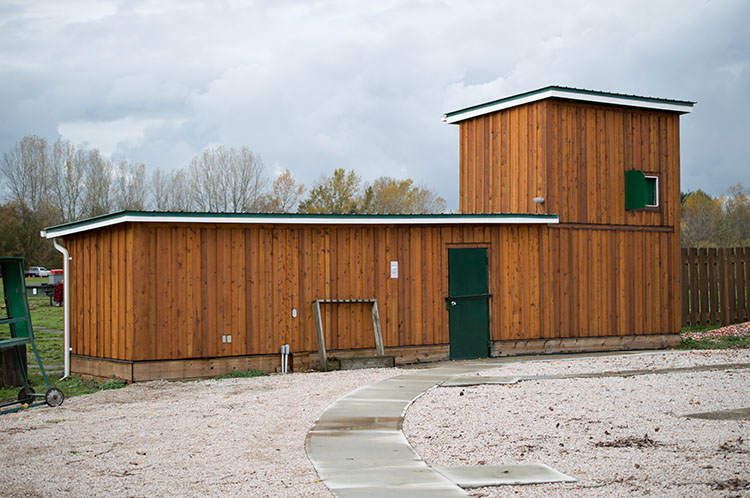 To shoot the game, the first shooter takes their position and readies themselves by loading no more than two shells, before bringing the gun to either the low ready or shouldered position (either is acceptable). A target is called for, and a single target is thrown from the high house, leaving the shooter with a target travelling directly away from them. After the shot is taken, the shooter sets up again, and calls for a second target. This target will be thrown from the low house opposite the shooter, and will quarter towards the shooter. With that shot taken, the shooter loads two more rounds, and calls for their third target presentation. This time, targets will be thrown from both high and low houses simultaneously. This cycle of high house then low house singles, followed by a simultaneous pair, is repeated on shooting stations one, two, six, and seven. And stations three, four, five, and eight, the sequence of targets is simply a high house single followed by a low house single.
 Etiquette: Skeet is typically less formal and more social, and it is not uncommon for participants to chat behind the shooter between turns, so long as it doesn't distract the shooter. However, due to the reverberation of each shot off the skeet houses, many skeet fields restrict shooters to a minimum barrel length of typically 22" or greater in an effort to reduce noise levels.
Tip: On station one, ignore the skeet house and concentrate on where the shot will be taken, because if you're thinking about where the throwing machine is you'll end up with a gun pointed too high, and the target will disappear behind the barrel as you chase it down.
Other versions to try: Olympic skeet. Like Olympic trap, Olympic skeet uses targets that move faster than conventional skeet targets, and are released at a random interval after the target has been called for. Compounding that, shooters must also call for the target from a low-ready position, with the toe of the stock close to the hip.
The third, and by far most diverse of the shotgun disciplines is the family of shooting sports known as sporting clays. Intended to most closely simulate hunting excursions and sometimes referred to as "golf with a shotgun," sporting clays may be the newest of the shotgun games, but has managed to become one of the most popular in the roughly 30 years since it was introduced in America.
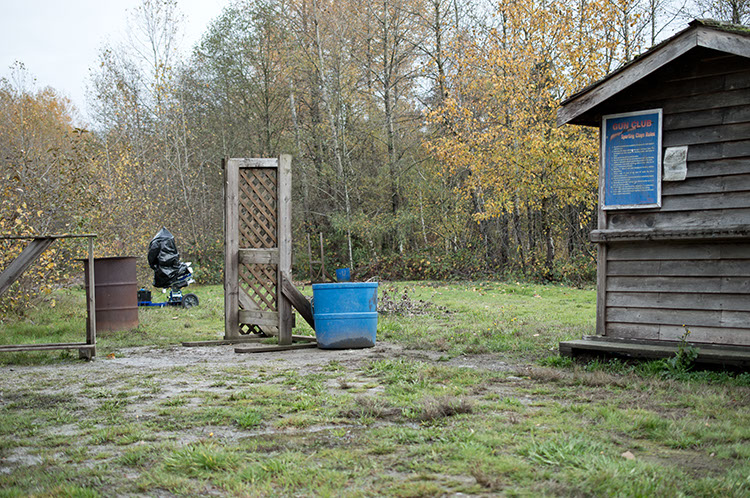 Unlike other shotgun games, sporting clays involves a course, rather than a field. Typically ranging from 10 stations on up, sporting clays courses usually occupy more than 35 acres, and provide the participants with all manner of targets and target presentations. Although initially designed to mimic the situations faced by hunters in real-world situations, the game has evolved somewhat to include some gamesmanship, and course designers frequently set up courses to create uniquely difficult shots combining various targets and angles.
The typical sporting clays round involves, as with so many other shotgun games, squads of shooters walking the course and shooting the round together. Periodically positioned along the course, the shooting stations frequently take the form of an empty door frame, and each shooter steps up the station, loads no more than two shells and calls for their target.
In sporting clays, the targets at any given station may be thrown in one of four ways; singles, a true pair, a following pair, or on report. Singles are obviously thrown one at a time, while a true pair is thrown simultaneously. A following pair is a pair of targets thrown in succession, with a slight delay between the two, while a pair "on report" consists of a single target thrown followed by a second thrown when the first shot is taken. In this manner, each shooter will have five opportunities to engage the target sequence at each individual stage, meaning anywhere from five to 10 rounds of ammunition will be used per station.
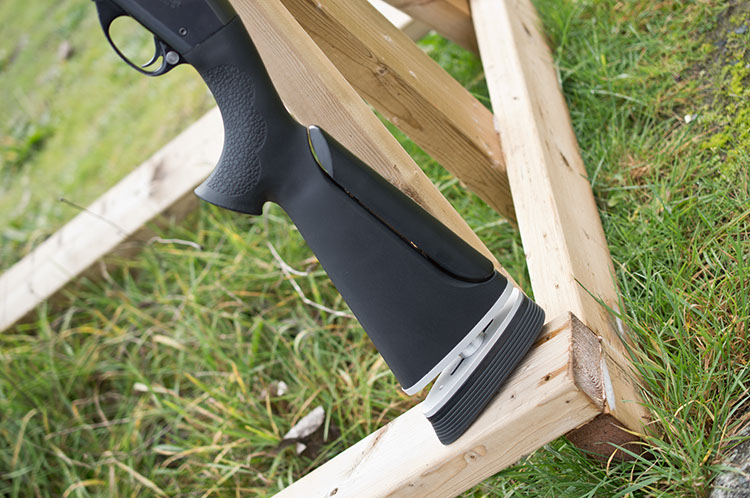 The targets themselves will be discharged from conventional trap machines set up by the course creators in any number of locations. Targets may be heading towards the shooter, away from the shooter, or any variety in between. Targets may also be thrown low or high, with one specific target known as the "springing teal" being thrown almost straight up vertically. Long crossing targets are also popular, as are target arcs that take into account the natural geography of the course; with many courses using water features like streams and lakes to their advantage. Some courses even sink waterproof boxes into the reedy shoreline of a water feature to simulate a roused waterfowl, or install throwing machines in tall towers to emulate a bird taking to flight off a tree branch. In sporting clays course development, creativity is key, and it's one of the aspects that makes the game so enjoyable. Just as golf courses move the hole around the green, most courses regularly rest their targets to keep the game fresh.
Sporting clays courses also use specialized sporting clays targets. These include midi- and mini-size targets, as well as battues and rabbits. Midi targets are roughly 2/3 the size of a standard target, and mini targets being roughly half the size of a standard target, making both of them not only harder to connect with but also harder to hit due to the higher speeds at which they are thrown. Battues are not concave targets like the others, and are simple flat discs roughly the same size as a standard target, which means they do not have any degree of "float" to their flight nor do they slow down as much as the less aerodynamic domed target. They come off the thrower hard and fast and sometimes disappear into the foliage before you can even get a clear view of it. The final specialized sporting clay target, and one of the most enjoyed, is the rabbit. Flat like a battue and roughly the same size, the rabbit is a heavier-weight target that is thrown by the machine in an underhand fashion, so that it rolls on edge across the ground. Of course, the ground in question is never totally flat, so these targets usually carom unpredictably off any slight imperfection on the ground.
Etiquette: Sporting clays is the least formal of the shotgun sports, and part of that "golf with guns" mentality comes from the easy, social atmosphere that pervades most courses. Expect lots of conversation to spice up the experience.
Tip: On springing teal targets, do not be overeager, and instead look to take your shot at they reach their zenith, as that is when they're moving slowest. On rabbits try and shoot the bottom edge off the clay, as it'll keep the target in sight and, due to the fact that most sporting shotguns throw 60% of their pattern above the point of aim, will keep more pellets on target.
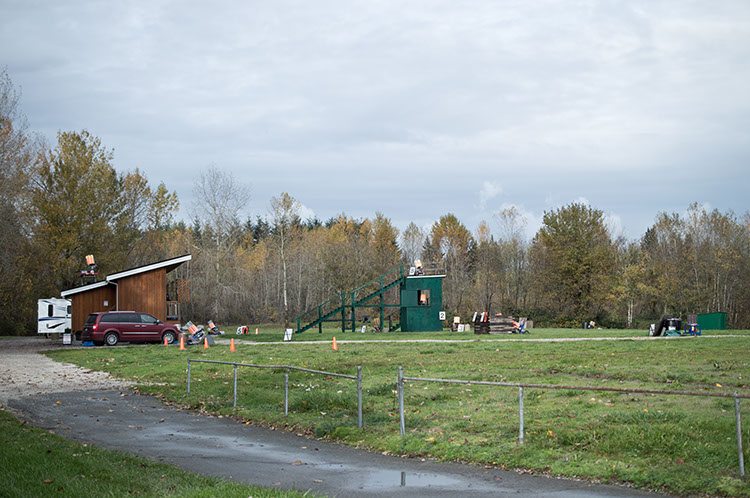 Other versions to try: 5-stand. Essentially a sporting clays game brought to a field setting, rather than an expansive course, shooters cycle through a simple line formation and engage targets thrown from machines positioned in much the same fashion as sporting clays courses. Considerably cheaper to operate, 5-stand is gaining popularity very quickly, and provides much of the same shooting experience as sporting clays albeit without the nice course-walking aspect.

 SUBSCRIBE TO CALIBRE MAGAZINE
$30.00 / year
SUBSCRIBE TO CALIBRE MAGAZINE
$30.00 / year
 UNAPOLOGETICALLY CANADIAN MEN'S T-SHIRT
$29.00
UNAPOLOGETICALLY CANADIAN MEN'S T-SHIRT
$29.00
 UNAPOLOGETICALLY CANADIAN WOMEN'S T-SHIRT
$29.00
UNAPOLOGETICALLY CANADIAN WOMEN'S T-SHIRT
$29.00